Early in the afternoon, we arrived by ferry to Korčula, the sixth largest island in the Adriatic, an island of sun, stone, wine, as well as ancient history, tradition, mythology, and beautiful nature. For a long time it was also known as the island of artists, intellectuals, travelers, merchants, and cosmopolitans… An island where ‘history lives in the present …’
First, we visited the heart of the island, surrounded by towers and walls – the town of Korčula, which is considered one of the most beautifully preserved medieval towns on the Adriatic. According to some data, the ‘most famous citizen of Korčula’, Marco Polo, was born here. Still, of course, the Italians (like the Odysseus Islands) do not want to know anything about it. 🙂
We entered through the Land Gate and set out to explore the narrow streets that are built in the shape of a herringbone, many towers, the cathedral, (mostly closed) shops, the port, the promenade …


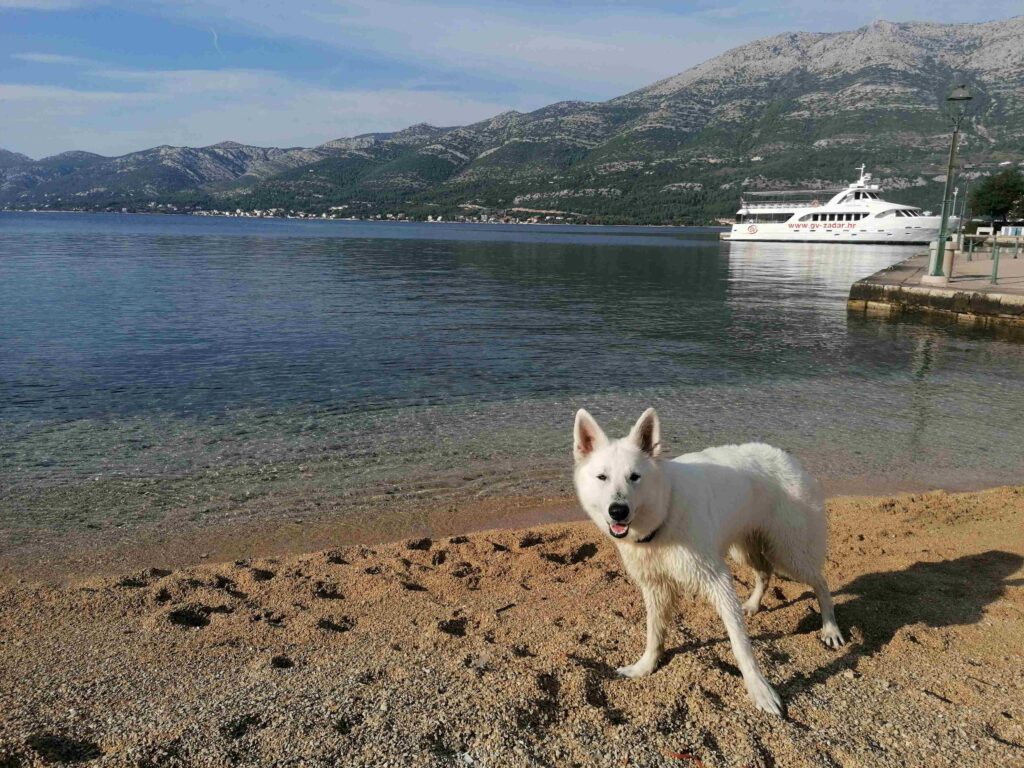
Then we drove passed many vineyards, olive groves, and pine forests … to Vela Luka, 42 kilometers away. In the meantime, we visited one of the ‘most beautiful and romantic’ beaches on the island, Žitna Beach, near Zavalatica. But I was disappointed. On the beach, a whole pile of trash, quite a strong wind, and of course, again forbidden for dogs. This time we were not alone on the beach, also a French family was soaking in the sea, so we immediately drove on …


At sunset we arrived in Vela Luka, the largest town on the island and, as they say on the website of their tourist board: “A place of extremely talented artists and musicians, a place of tradition and hardworking and versatile people.” The most famous person from Vela Luka is musician Oliver Dragojević with his dalmatian music …

I booked a room on the edge of the city, but I was soon informed that they couldn’t host me at the moment and if I wanted to stay in a hotel in the city center for the same price. Which, of course, I accepted after confirming that a puppy was also welcome.
And so we found ourselves in the Korkyra Hotel, on the top floor, with a balcony and a view of the harbor, so that I could watch the docking of ships from behind the glass wall while showering, and Tara didn’t have to ‘guard’ me directly in front of the shower door, but she could control everything from the bed… 🙂

The staff turned out to be very friendly, they took care of us wonderfully, among other things, with a very tasty and abundant breakfast, which I wanted to pay for, but the computer did not allow it …

I didn’t use the possibility of the free fitness, sauna, and parking throughout the city, instead, in the morning we walked to the Hum hill above Vela Luka. A panoramic, marked as an easy (for me quite strenuous) mountain trail leads past the shipyard, climbs in the shade of forests, past olive groves … to the ruins of the Austro-Hungarian fortress at the top, where today stands an observatory for possible forest fires (similar to the one at the top of Montekuc in Mljet). Completely soaked undershirt paid off – the 360-degree view all around, including the neighboring islands, paid off the effort. Instead of an hour and a half walk from the city center, you can reach the top in 20 minutes by car. 😉


In the afternoon, we walked on another hill – Pinski rat – to visit the cave Vela Spila – one of the most important prehistoric archaeological sites in Europe.
“Vela Spila is the point where Western social thought, culture and civilization originated about 30 thousand years ago. The blue ray shows the way and the direction, after all, it indicates the point at which (in this part of Europe) the consciousness of one’s own existence, of the existence of the mind and the idea of its expansion, appeared. The blue color indicates the flow of consciousness, from the mountain to the cave, from the cave to the harbor. The blue trail indicates the direction of the arrival of the blue color in Vela Luka,” says their website.


Vela Spila is referred to as the “cradle of Western civilization.” People lived here 20 thousand years ago, at the time when Korčula was a hill and not an island. The cavern at an altitude of 130 meters, about 40 years long and wide, has two openings in the ceiling, was inhabited by several prehistoric communities, and also served as a cemetery.


Today, in these 200 square meters of the cave explored, in this ‘time capsule’, we can observe the progress of life from the last ice age to the present day. For this purpose, there are a few informative (also interactive) boards with descriptions of life, people, animals, flora, etc., and there are also many finds on display that testify to the cultural, social, spiritual, and economic history of Vela Spila, the Adriatic and the Mediterranean from the Palaeolithic to the Middle Bronze Age…
From the cave, we walked to a dog beach on the edge of the town and came across a “place to love” that celebrates love. Well, I could only enjoy the embrace of nature, silence, and the sea, Tara quickly ran away … 🙂


On the way back, we had dinner at a restaurant along the harbor promenade, and it was not without a fight with the cats around the tables … 🙂

In front of the entrance to the hotel, I also saw the mosaics created by the Vela Luka Association of Fine Artists, with the aim of creating a mosaic built into the Port promenade, which would become the longest floor mosaic in the world. The first mosaics in the place were created as part of the First international meeting of fine artists in Vela Luka in 1968, when artists turned the city into an art center with the purpose of uniting. In addition to individual mosaics, one collective mosaic stands in front of the Korkyra Hotel, depicting a dove with an olive branch – a symbol of peace, and the coat of arms of Vela Luka.


In the evening, I thought about Circe… Here’s a quote from the book Circe by Madeline Miller (from the website with a book review):
“In the house of Helios, the sun god and the mightiest of the Titans, a daughter is born. But Circe is an unusual child. She is endowed neither with the divine power of her father nor with her mother’s pernicious charm. When she approaches the mortal world in her quest to find friends, she discovers that she has been given her own, very special power – the power of sorcery, with which she can turn opponents into monsters and take on equal footing with the rulers of Olympus themselves. Out of a sense of threat, Zeus takes her to a deserted island, where Circe devotes herself to perfecting her mysterious skill. Here her path intersects with the lives of many of the most illustrious figures of ancient mythology: the Minotaur, the terrible bull-headed monster, the Daedalus, the builder of the Minoan labyrinth, and his son, the untried aviator Icarus, the unfortunate murderer Medea – and, fatefully, the cunning sailor Odysseus. But many dangers are lurking for a self-sufficient woman. Circe inadvertently summons the wrath of men and gods until she finally finds herself in the middle of a feud with one of the most terrifying and vengeful Olympians. To protect what is most dear to her, she must use all her power to decide whether her place is with the gods on Olympus, where she was born, or with mortals on earth, where she loved.”
I wished for her wine (Grk – Greek), with which she was supposed to turn Odysseus’ friends into pigs, as the people of Korčula say. 🙂 I was going to look for the bottle the next day, and take it home with me to toast to a new life in my new home (both unknown at the time). This variety of white grapevine has only female flowers, so another type of grape must also grow nearby for pollination to occur, and due to its specificity, it is quite rare and expensive.
But at night, the thought settled in my head that I didn’t want to turn anyone into a pig or monster and therefore I didn’t need it. 🙂 Instead, we passed many wineries on Korčula and Pelješac and drove directly to Ston …