Murter is another Adriatic island, inhabited in prehistoric times and in the era of the Illyrians – it was inhabited by the Liburnians and Romans. In the vicinity of today’s settlement of Murter stood the town of Colentum, founded by the Liburnians in the 11th century BC, and was, next to Zadar, the most important port of southern Liburnia…
The origin of the name Murter, which many remind of death, is actually related to a stone trough, part of an oil press (mortarium), which indicates a long tradition of olive oil production…
Tara and I rented a room in the town of Betina and upon arrival, we first went for a walk to the capital town by the sea, past olive groves, pine trees, and an archaeological park with the remains of the ancient town of Colentum. Instead of machine sounds, human voices resounded from the plantations, and Dalmatian music or the Slovenian accordion resounded from the sea and passing sailboats. 🙂


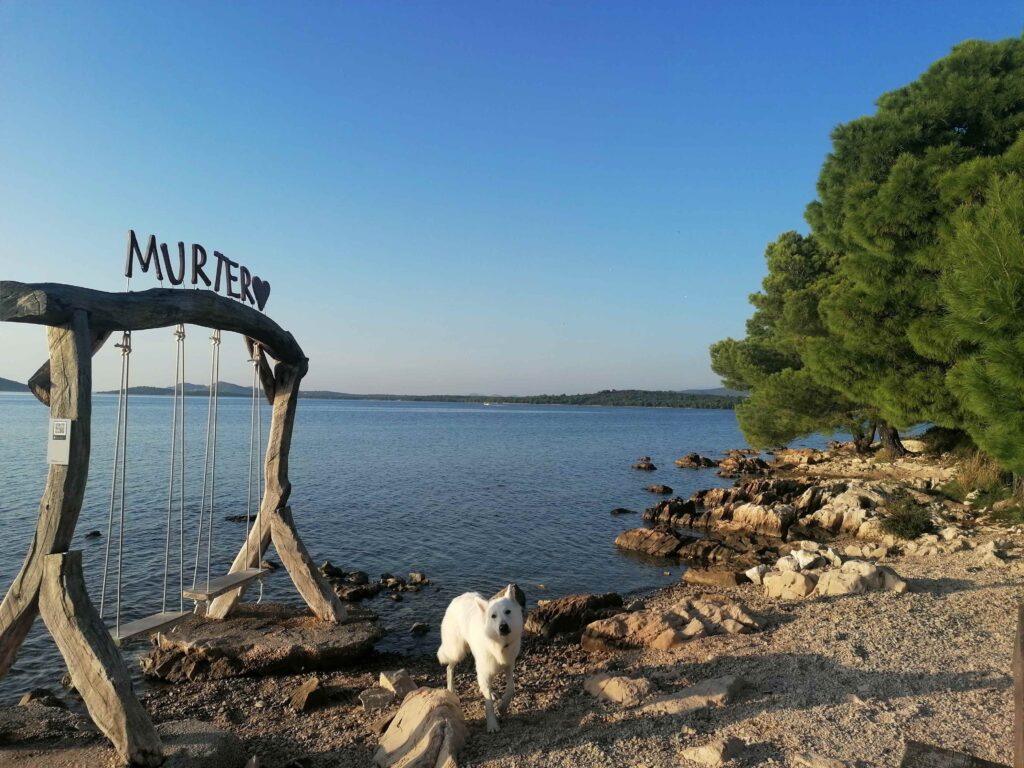
In Murter, too, most bars and restaurants are closed in the off-season, but there are three or four open bars that accept puppies on their terraces. The main guardians of the streets and restaurant tables on this island are also represented by fearless cats, so it is necessary to pass them with a great bend. Or even to call a waiter for help so a fish can be eaten in peace and there is no wild fight between dog and cat gluttony under the table. 🙂

What this time was the only contact with the locals, the ‘Murters’ – they were supposed to have been pirates in the past and robbed Venetian ships, and they came to the ownership of the Kornati islands through the violent expulsion of the Sali people, who were supposed to buy the archipelago from the Venetians. I also kept in touch with the owner of the rented room only by phone.
The most interesting thing I found was that on my side of the phone, the booking request for an extra night was denied, and a kind lady sent me a screenshot of her screen with the approved request. What turned out perfectly in the end, everything has its reason, including a computer ‘error’: I didn’t plan to visit Pag before, so instead of wandering around this island and looking for inner peace, I experienced ‘my’ much-needed olives the day before…
The next morning, before leaving, we walked through Betina, which is considered to be one of the most beautiful towns on the Adriatic – with its narrow, cobbled streets and the church on the hill, it reminds me of Piran. The name Betina is said to have originated from the Celtic word ‘bet’ = mouth, because the Betina port has the shape of a mouth.

It is also known for its shipyards, where ships have been built from wood since 1740, and is unofficially considered to be the center of Adriatic shipbuilding.

The ‘Betina gajeta’ is a wooden ship 5-8 meters long, 2-2.6 meters wide, and without a deck, which was used for the transport of olive oil; but I was interested in what kind of ship King Edward VIII sailed around the Kornati Islands. He spent the summer of that fateful year among the islands and apparently was deciding right here, whether he wants the royal crown or the beloved woman … Answer: it wasn’t the gajeta, but it was the fastest yacht in the world at the time (Nahlin) that apparently drove him to love.
There was no time for any more wandering this time, and this was the fifth time for me being on Murter so I already saw all the beautiful bays with views of the Kornati Islands. The Betina Museum of Wooden Shipbuilding I left to visitors without a dog.

In the center of the town, everything was closed, so I drank coffee on the terrace of a room by the sea, and then on a sunny morning we continued with the next stage of jurney: past Šibenik, Split and stopped for coffee and a walk in Omiš, where Odysseus with 12 ships was supposed to anchor on his odyssey.
On their way home to Ithaca, they stopped at the mouth of the river along the seashore, surrounded by steep cliffs. Odysseus’ companions sailed through this narrow entrance, but the cunning hero left his ship outside the harbor, which turned out to be very wise. In fact, in this ‘wild’ area lived the Lestrigonians, wild giants who threw rocks at them and sank ships, only Odysseus was saved… While some theories say that this have happened in Sardinia or Sicily, the travel writer Jasen Boko, supported by a lot of evidence, claims that it happened in Omiš …

The path then led us along (in my opinion) the most beautiful part of the Adriatic Highway: the Makarska Riviera, the Neretva River Valley, to Ploce …


… then along the Pelješac Bridge and Pelješac peninsula to the port of Praprotno, from where (before sunset) we sailed towards Mljet …


