The Slovenian part of the Karst lies in the southwestern part of Slovenia and stretches between the border with Italy, the Vipava Valley and Brkini. The capital of the Karst on the Slovenian side of the border is Sežana, also called the Karst metropolis, and in its vicinity stands one of the oldest stud farms in the world – Lipica.
Miraculous Karst
Marko Pogačnik, in his book Slovenia Miraculous (from which part of the following data comes), mentions the Karst as a landscape sanctuary that begins in the northern part of the Karst Plateau above the Vipava Valley, where the center of its breath lies. It is centered on a pyramidal hill, around which the town of Štanjel has developed, and the center of life is the area of the Lipica stud farm. Štanjel, Lipica, and Socerb lie on the White Axis, which runs from Triglav to Cape Kamenjak.
The Karst is a high limestone plateau without a surface stream, river or lake. Because the limestone is porous, all water immediately drains underground, with the exception of shallow reservoirs intended for watering livestock, called kali.
Water as a carrier of life occurs exclusively in the belly of the Earth, which led ancient cultures to perceive the Karst as a vast landscape sanctuary of the Virgin Goddess – like an egg, in which the embryo is hidden in the solid shell of limestone. “If a person visits the Karst, he is actually walking on the shell of an egg, while the life force still beats deep down in the Karst interior. What flows through the underground waters of the Karst is life before life …” (p. 92)
The Karst is a surprisingly fertile land thanks to the sanctuaries in the form of piled stones or circular mounds, such as those seen at Debela Griža near Volčji grad, at Gradišče near Črnotiče, or at Sveti Mihael near Kazlje. They are a medium for communication between the human race and the divine core of the Earth, and with their mineral composition, act as magnets, drawing to the surface the properties of water flowing in underground tunnels. The hillforts were built at a time when cultures still understood that life on the surface of the Earth was a gift from the heart of the Earth and the core of the Universe, not something that was taken for granted.
Lipica and the Lipizzaners
Lipica stands at the point where the water impulse of the Mediterranean and the fire impulse of the Alps meet and fertilize each other. “The power of Lipica lies in the fact that it represents the place of marriage between water and fire.” (p. 97)
In addition to the white horses, Lipica is also distinguished by its precious oaks, which were planted in the 16th century and still grow today. “Each of the Lipica oaks represents a pillar of the sanctuary, connecting the famous Karst underground with the starry constellations in the sky. Each oak is similar to a double funnel, through which forces and knowledge flow between Earth and Space.” (p. 97) But these forces, which flow between heaven and earth through the trees, could flow past us and the body of Slovenia, if there weren’t white horses, which reside there as an indispensable element of the space.

Lipica horses are necessary for maintaining the vitality and mental capacity of the Slovenian space. Together with the oak grove, they participate in maintaining the energy membranes, through which the dance of water and fire is translated into horizontal flows of life and creation. The oaks maintain the vertical, around which the vortex winds in height and depth, and the horses ensure the translation of its forces into the cultural layers of the land. “Lipica is an example of brilliant cooperation between the plant and animal kingdoms and the landscape.” (p. 99)

The mares give birth to dark-haired foals, which in a few years grow up and transform into fairy-white horses. Based on the obvious kinship with the transformations of alchemy, in which the black phase is followed by the transformation and the blossoming of the ‘stone of wisdom’, Pogačnik claims that the Lipizzaner horses are relatives of the fairy world.
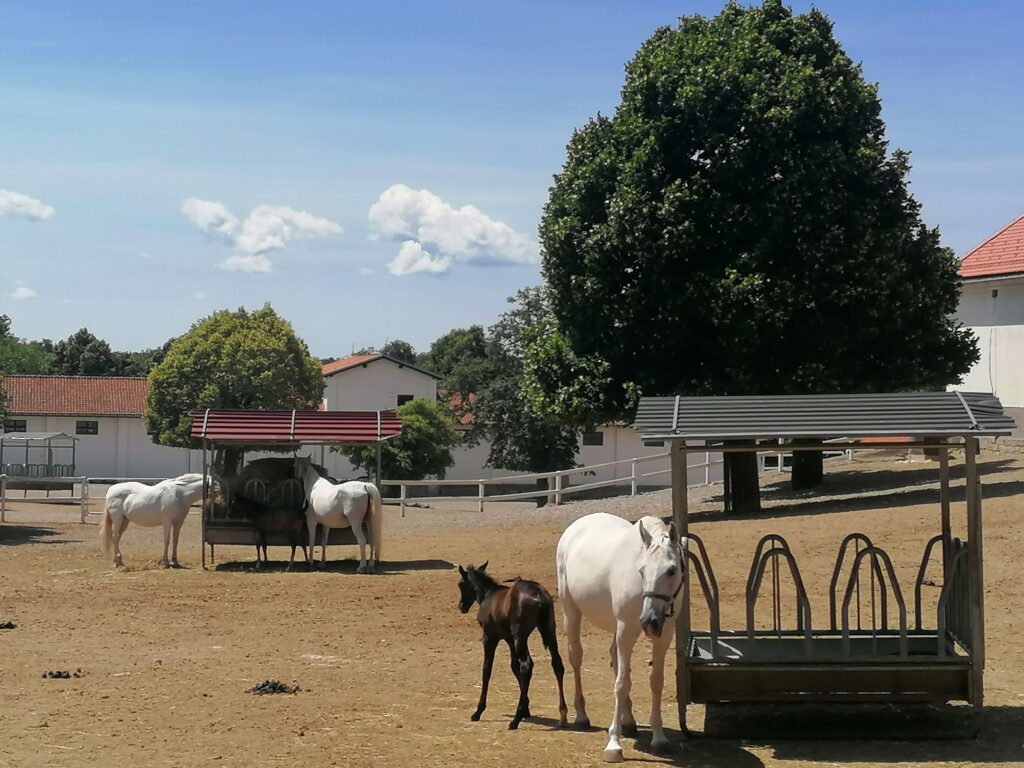
But their life path is not easy. Over the centuries, man has subjected them to his will and whims, pushing the influence of his individual elemental being to the edge of the horse’s sphere of consciousness, under its hind legs.

“If I uncover the projection of the human will for a moment, I allow the elemental being to immediately spread throughout the stallion’s entire body. Then the horse gains wings like Pegasus – a mythological memory of the prototype of the free horse. I can also see that the Lipizzaners are constantly telepathically connected to each other in an inseparable family. At the same time, each one is individually in contact with the prototype of their species. Each one is a mare or stallion for himself.” (p. 99)

The Lipizzaner also touched me in a special way. First, during the weeks of grounding after ritually drinking a cup of ayahuasca in the Netherlands, he entered my life at the beginning of 2019 through a short story that wanted to be written through my hands. In it, he escapes from the oldest European stud farm and, after three days of wandering, finds himself in a fairy cave (Vilenica, which will be discussed in the next blog). There, the fairies reveal to him the different levels of existence …
From then on, for several years, I visited the Karst practically every weekend, and Lipica at least once a month. During a gong concert, leaning against the trunk of a mighty tree, I came to the surprising discovery that gentle persistence / persistent tenderness is just as powerful and effective as hard-hitting determination. If not even more …
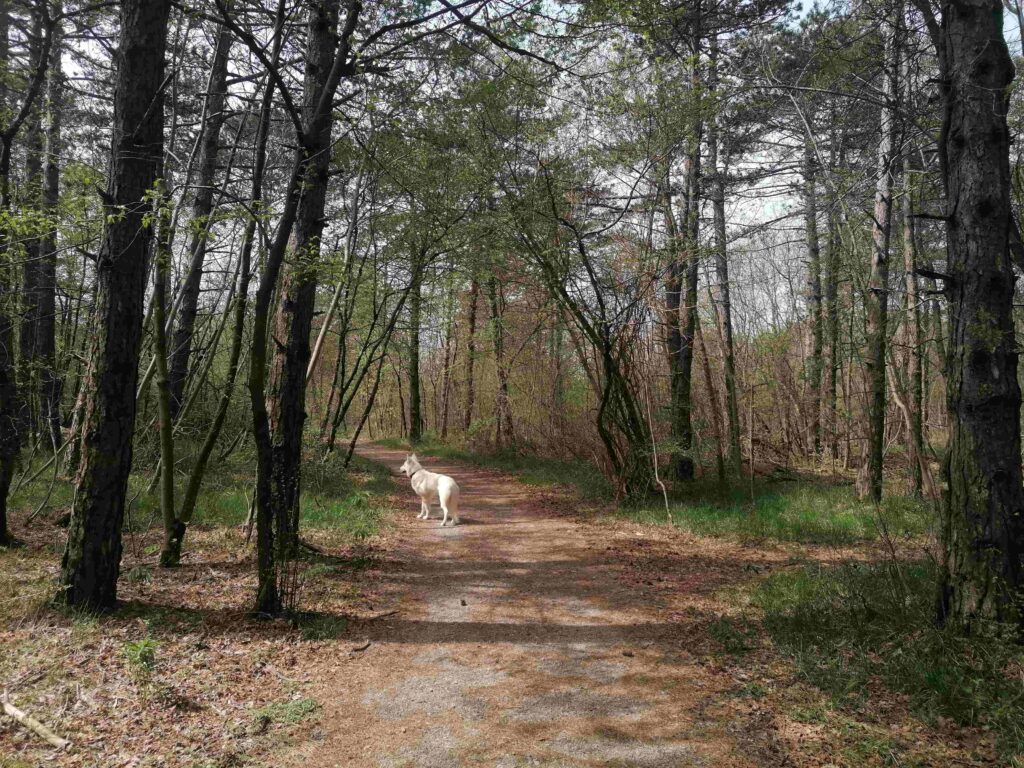
I enjoyed walking through the Valley of Marija Lurška in the area of the stud farm and the Josef Ressl forest educational trail.
From 1848 to 1875, the Lipica stud farm was run by Karel Grunn. He was seriously ill with tuberculosis and sought health in a nearby sinkhole. He spent his days there until he recovered. In gratitude, he had built a chapel, carved into the natural wall, and a statue of the Mother of God translates the blessing for the entire area. He arranged the entire valley with paths and had flowers planted. Thus, the valley of the small karst sinkhole became a small sanctuary, an open-air church, and numerous miraculous healings took place there. Until World War II, people, especially from the Trieste area, made mass pilgrimages to this place.
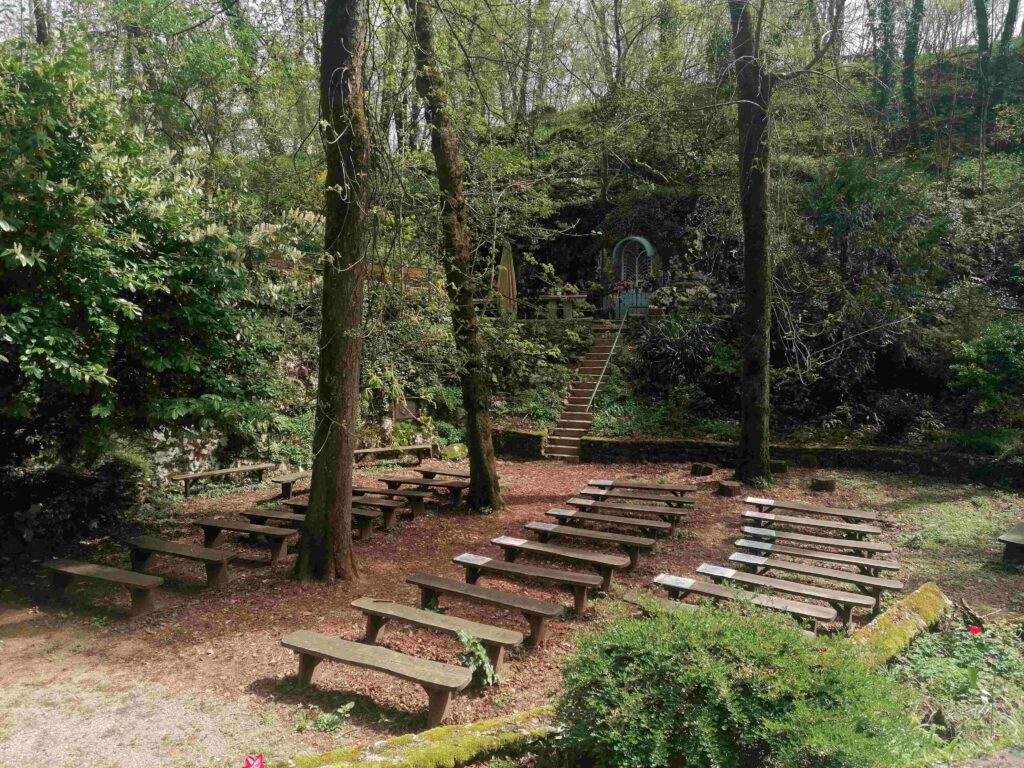
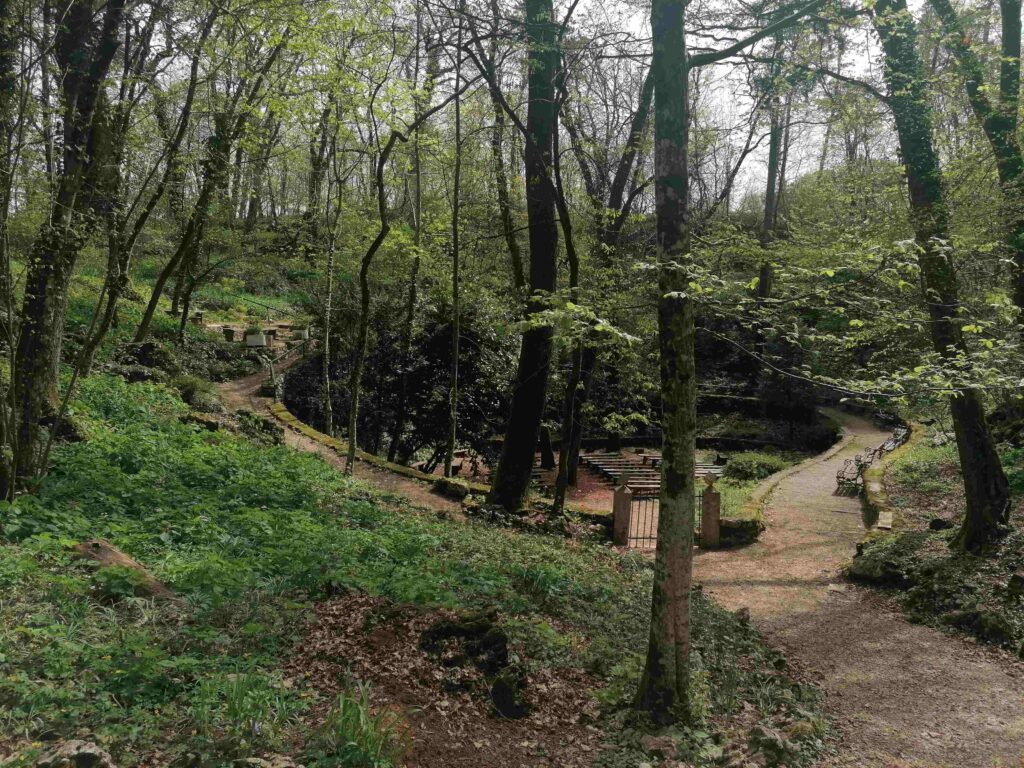
Pogačnik claims that it is quite burdened with unprocessed human burdens, but there are many other sinkholes in Lipica, whose healing power does not come from the sky, but from the underground.
An interesting walk in the surroundings is offered by the Josef Ressel forest educational trail, which leads through the forest to the Italian border and beyond. In the first half of the 19th century, when France Prešeren was awakening national consciousness, Josef Ressel devoted himself to pioneering the afforestation of the karst bare areas. He knew that the Venetians were not to blame for the bare stone pastures, but the survival needs of the locals, who, since the Iron Age, have decimated the forest – the guardian of the living environment of plants, animals and people – with excessive logging and grazing …
Horses
I also took a group of Slovenian language students to visit a stud farm in Lipica…
But my national pride quickly faded when we learned how these beautiful horses are treated. All appeared to be perfect, they have plenty of space, careful care, and attention in the form of dressage – the harsh Spanish school that Pogačnik doesnt like – but I was surprised and saddened by something else. The precious mares and stallions are separated early for safety reasons. Insemination is also done artificially, a stallion comes into contact with an artificial mare, which is headless; the head is not needed for the act.
How do you explain to a 7-year-old boy what this device is or what it is for? “Ah, forget it, something sad,” was the Bosnian mother’s response to the question.

I also didn’t like that the mares are trained to respond to the sound or crack of a whip when they are called to bring their herd from the pastures back to the stud farm. Given my belief that we treat animals (and all of nature) on some level the same as we treat ourselves and other people, this does not exactly paint Slovenians in an attractive light…
But I have no real experience with horses to judge what they need for a fulfilling life. Just thinking about them has thoroughly stirred my emotional state and caused quite a few sleepless nights.
As a counterbalance, I came across the recording from the largest private Lipizzaner stud farm in Slovenia and Europe – Kobilarna Hosta. It is located in Šentjernej. My heart skipped a beat while watching the recording of a simple rolling on the ground and the recording of a mare walking through a lush forest – with her owner on his own two feet – during which they came across a bird and moved it from the path to safety …
I then re-watched the award-winning documentary that had touched me years ago. Herd – a spiritual journey presents a landscape with dragon energy, and animals as higher beings who help people overcome and transform traumatic events …
The pleasant realization that taming horses, necessary for riding, does not require the violent killing of their spirit came from the documentary Horses: Our Hearts Still Beat as One.