The summer of 2025 was marked by Croatian Istria. Settled in Novigrad, Tara and I explored the coastal town in the early morning hours or went on excursions to the surrounding areas.
In his book Slovenia Miraculous, Marko Pogačnik sees Istria as a tree of life. He wrote: “I feel and know that in the middle of the Gulf of Trieste, one of the energy centers in the ‘head’ of the Adriatic Sea is pulsating. Its influence has been translated by various cultures into the values of Oglej, Devin, Koper, Strunjan and Piran. Čičarija on the other side of the trunk is the exact opposite: a primeval, almost uninhabited landscape. It is a kind of repository of the primordial forces of Gaia, from which the life-energy organism of Istria is powered…“

NOVIGRAD
Novigrad (Cittanova) was (during the Migration Period) founded on the western coast of the Istrian peninsula – on a small island between Umag and Poreč. The islet on which it was founded (similar to Izola and Koper in Slovenia) was connected to the mainland in the 18th century.
Pogačnik claims that Novigrad is actually ‘New Ljubljana’, because it was built by the inhabitants of Emona when their original city on the Ljubljana Marshes was destroyed. “The former island is a sacred place of Gaia, the Mother of Life. Its energy structure, centered on the site of the present-day Church of St. Pelagius, resembles a rosette. It spreads in a circle over the former island and acts as the eye of Gaia. It is one of those rare places through which Mother Earth can look out over her creation on the surface of the planet and perceive how life flows – or perhaps gets stuck. Fortunately, there are a few small parks around the church that still allow the eye of Gaia to look out.“
Tara and I spent most of the morning walks around the beautiful Janez Ziherl Park, quenching our thirst in the dog park, and continuing our journey to the dog beach on the Pineta peninsula. This is located a little further from the Kastanija and the Oasis of Peace (apartment complex), which we walked past almost every morning during our stay.
The area by the sea with olive groves, vineyards, and pine trees reminded me a lot of Debeli rtič (in Slovenia), only it is much larger and easier to reach. Also, parking by the dog beach and the Dogs dream beach & bar is (for now) still free. But I’m not sure the bar is as dreamy as its name suggests, because wet dogs are not allowed on the terrace. So, in favor of swimming and jumping in the water, we declined dog ice cream and coffee.


A few times, we also walked around the eastern part of the city, where there is a large hotel with a pool, tennis courts, and well-maintained infrastructure, including a beach for dogs, but the well-maintained atmosphere did not attract us to return there more than a few times. We made an exception with the center, where narrow streets lead to the large Church of St. Pelagius, and through the eyes of Gaia observed how life on the surface of the planet proceeds and what it needs. This was revealed at the end of the summer, but by then we had visited a few more Istrian towns…
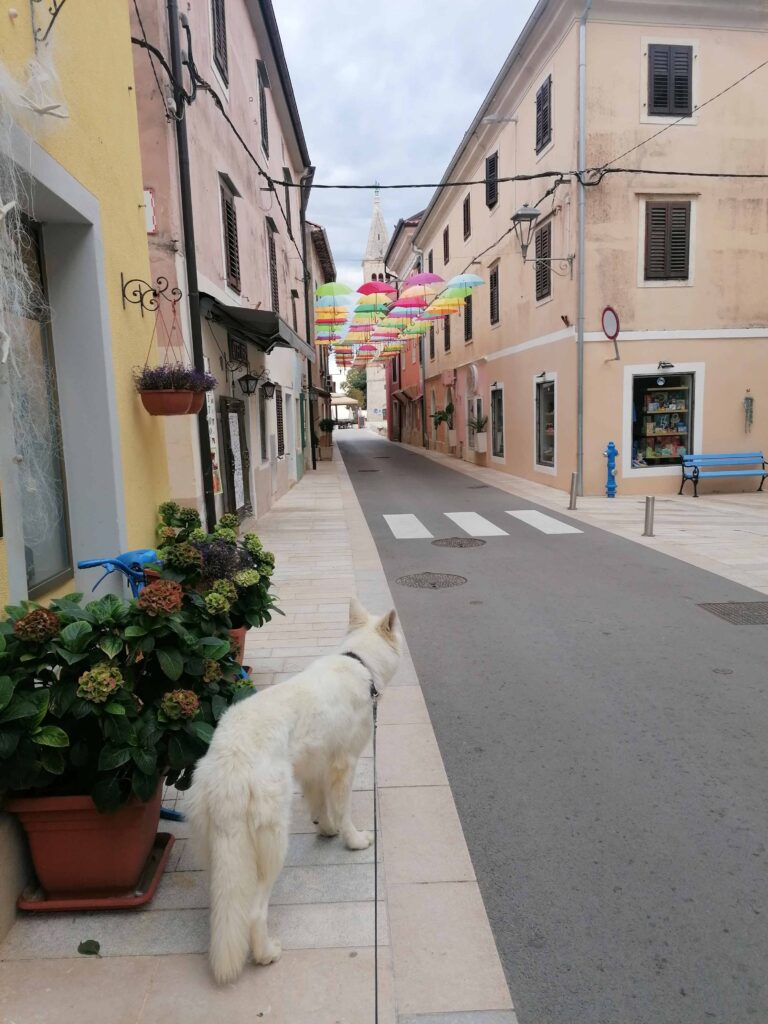

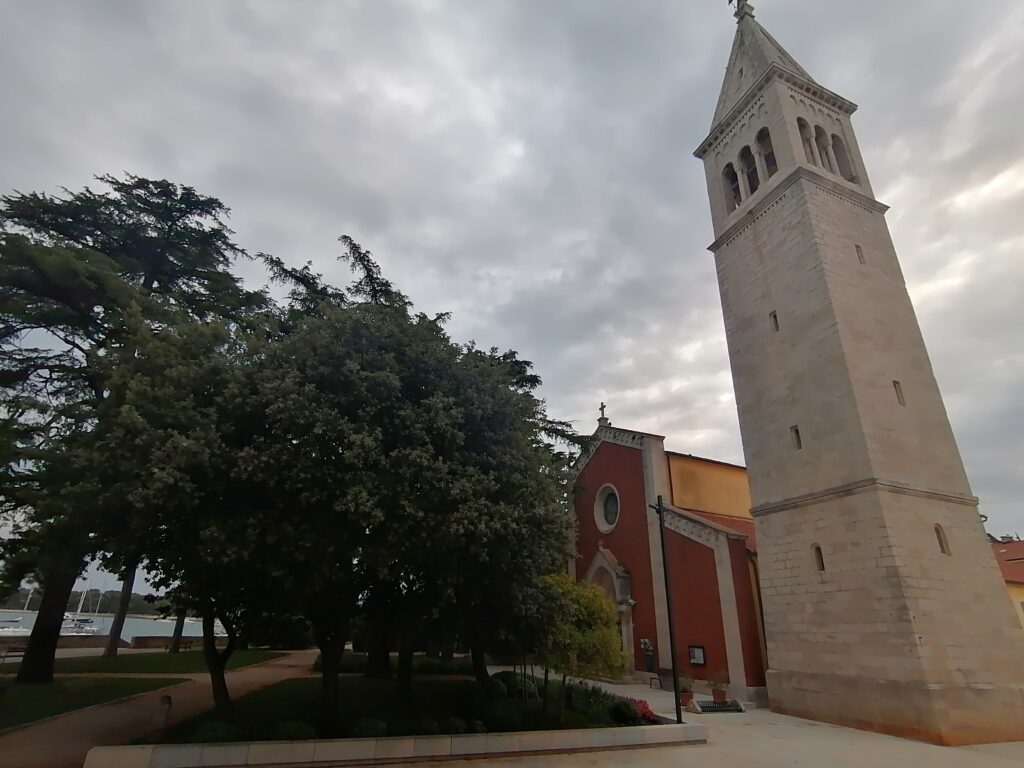
PAZIN
Pazin is one of the most important historical places in Istria, but it has a completely different character from the other coastal towns. The area was settled in Roman times and represented a strategic point on the way between the coast and the hinterland, but it was not Venetian. The county belonged to the Holy Roman Empire, and later belonged to the Habsburgs.
It played a major role in preserving the Croatian language, and it also inspired numerous travelers and scientists. Among the more famous ones mentioned in connection with the Pazin Cave are Jules Verne and Dante Alighieri.
The French writer described Pazin in his novel Mathias Sandorf, depicting it as a mysterious, dark, and mythical place:
The Hungarian Count Mathias Sandorf and his associates, who were sentenced to death by a military court for conspiring against the Austro-Hungarian monarchy, are imprisoned in a medieval fortress in Pazin in Istria. Sandorf manages to escape, descending a cliff into the abyss, and then the raging Pazinčica River carries him through the Istrian underground to the Lim Channel and Rovinj…
Verne left a big mark on the town with his writing. Wikipedia says:
Count Mathias Sandorf was in Pazin on June 26, 1867. In memory of this literary date, the first Jules Verne Day took place in 1998, which has been held every year at the end of June since then. The Jules Verne Club was also founded in the same year with the aim of uniting fans of Verne’s literature and also trying to popularize the reading, translation, and publishing of his books. At the same time, they organize Jules Verne Days, the Fantastic Literature Festival, and similar activities. So, the town of Pazin is presented as the town of Jules Verne. Between 1989 and 1990, the Mathias Sandorf amateur theater operated here. Next to the castle, there is also a Jules Verne Street.
The Italian poet Dante Alighieri, in his description of Hell in The Divine Comedy, surprisingly comes very close to the characteristics of the Pazin Cave: a huge karst abyss, a river that plunges into darkness, a castle standing over the abyss, a sense of depth, danger, the unknown. The Pazin Cave is said to be one of the best realistic illustrations of what Dante had imagined.


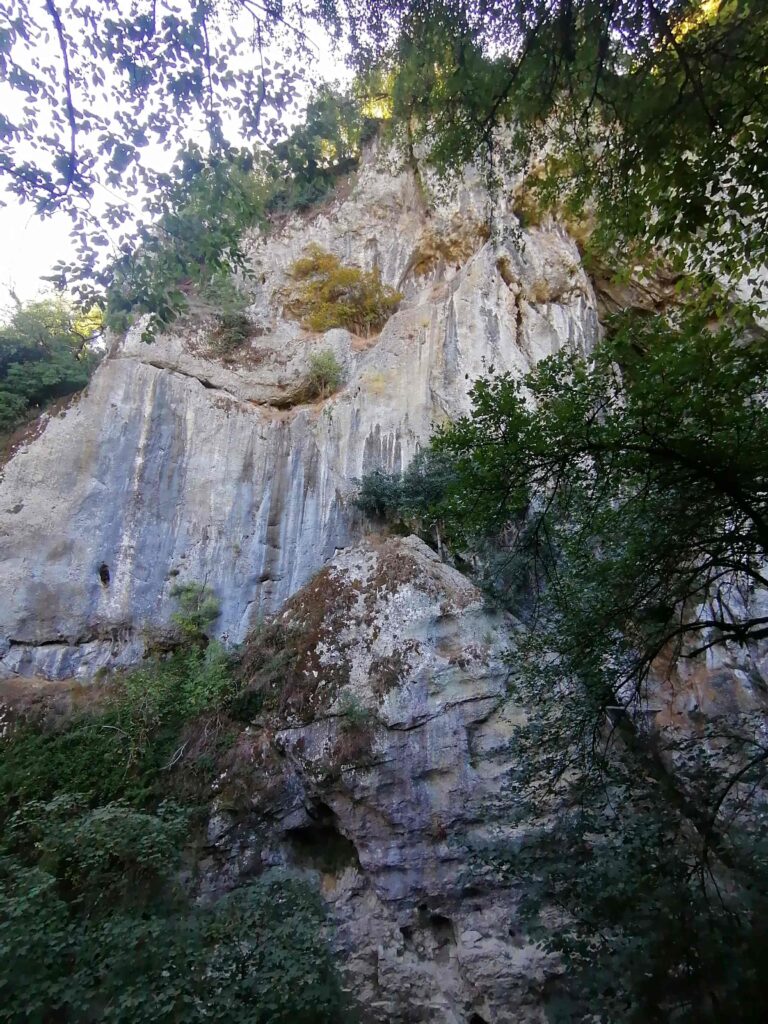

The Pazin Cave or Pazinščica Sinkhole is one of the first systematically explored karst caves, crucial for the development of speleology and karst hydrology. The entrance to it is under a 200-meter-high rock, and its interior hides two interconnected lakes – Martelovo and Mitrovo Lakes. Once, the Pazinčica River flowed on the surface past Berem and Dvigrad all the way to the sea, creating the Limska Draga. The Pazin Cave is protected by law and declared a very important landscape, which includes the Pazinčica Canyon and Sinkhole, and the natural Pazin Cave, which is 270 meters deep.
After a morning coffee in the charming city center, we walked along the footpath: The “Pazin Cave” hiking trail. It is 1,100 meters long and starts under the castle at the Vršiški Most bridge. The path descends into the Pazinčica canyon, leads through the forest to the “Pyramid” viewpoint, from where we can see the entrance to the Pazin Cave underground. The tour is independent, without a guide, and the path is equipped with multilingual signs that offer additional explanations about the karst phenomenon, hydrography, the flora of the abyss, legends, research, and brave explorers. The educational trail ends at the parking lot behind the Lovac hotel, and then returns along the edge of the cliff all the way to the Vršiški Most bridge.
To explore the cave itself, I should have booked a tour online, but only the ticket seller reminded me of this when I entered the educational trail. For a good half hour, spent in the surroundings of the cave, we also listen to the sounds of a zip line above us, and high above the abyss.
BERAM
Not far from Pazin, according to Pogačnik, is the energy center of Istria: Beram. “The hill on which this medieval town stands can be called the solar plexus of Istria. From there, the sun of Istria spreads its subtle rays across the land. The energy potential of the hill is complemented by the nearby Church of St. Mary on Škriline, the sister of the church in Hrastovlje in Slovenia … This is an example of the reincarnation of a sacred place. At first glance, it is a normal medieval building. However, a deeper look reveals that in its background stands a temple with a characteristic triangular gable and a columned facade made of white marble. The place thus reveals its age, which reaches beyond the horizon of our contemporary space and time, far back, judging by the feeling, to the age of Atlantis.”
Beram is one of the oldest continuously inhabited places in Istria, it was already inhabited in the Iron Age. It was also one of the most important centers of medieval Glagolitic literacy. This is also evidenced by the carvings on the walls of the church in Škriline.
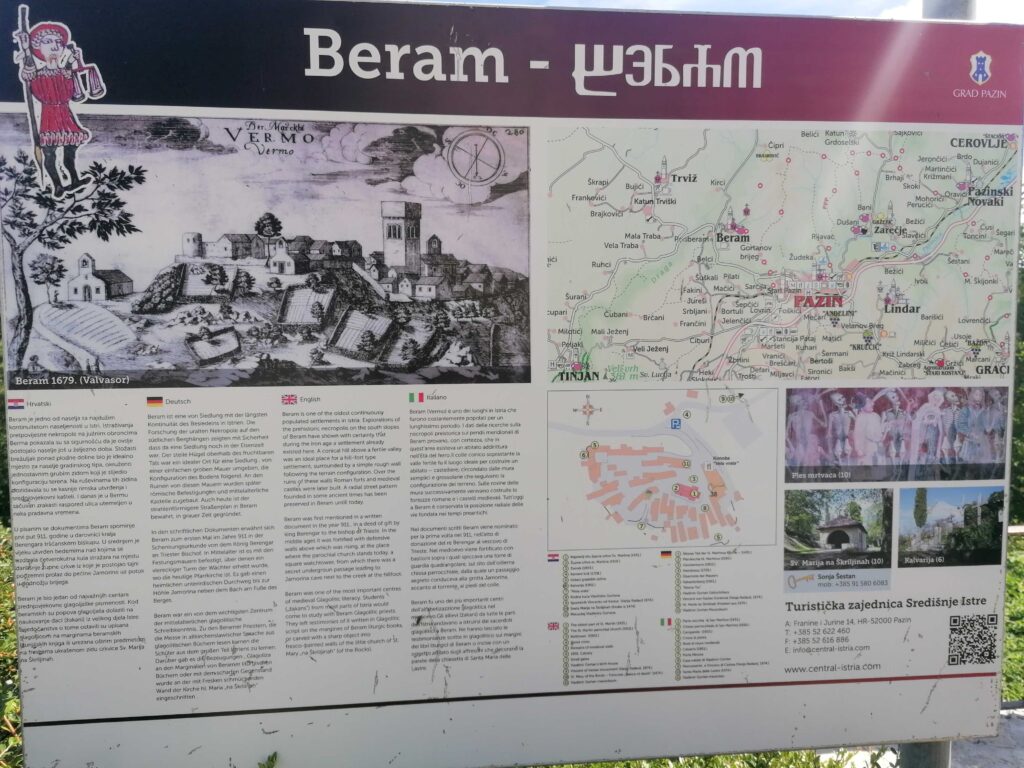

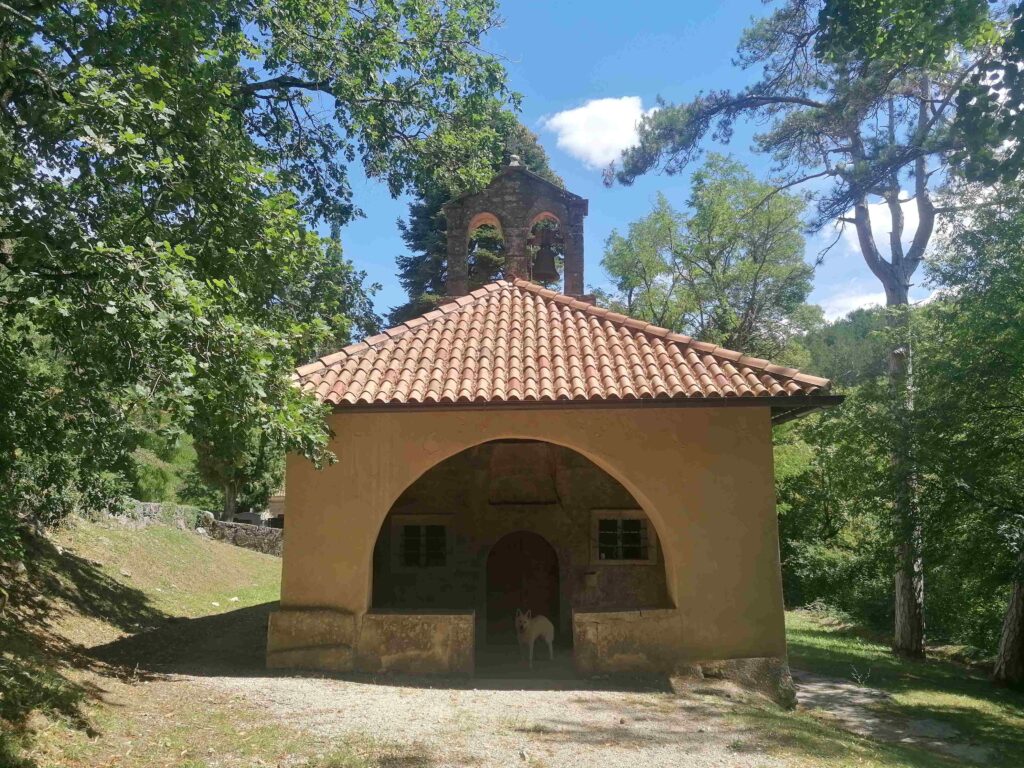
Unfortunately, the church was closed, but I bought some homemade Istrian products from the farmer sitting in front of it, which will ‘enlighten’ me in this winter nights – including homemade olive oil. Lunch followed in the only tavern in the town, where at 11:00, when the restaurant opened, almost all the tables on the terrace with a beautiful view of green Istria were already occupied or reserved.
DVIGRAD
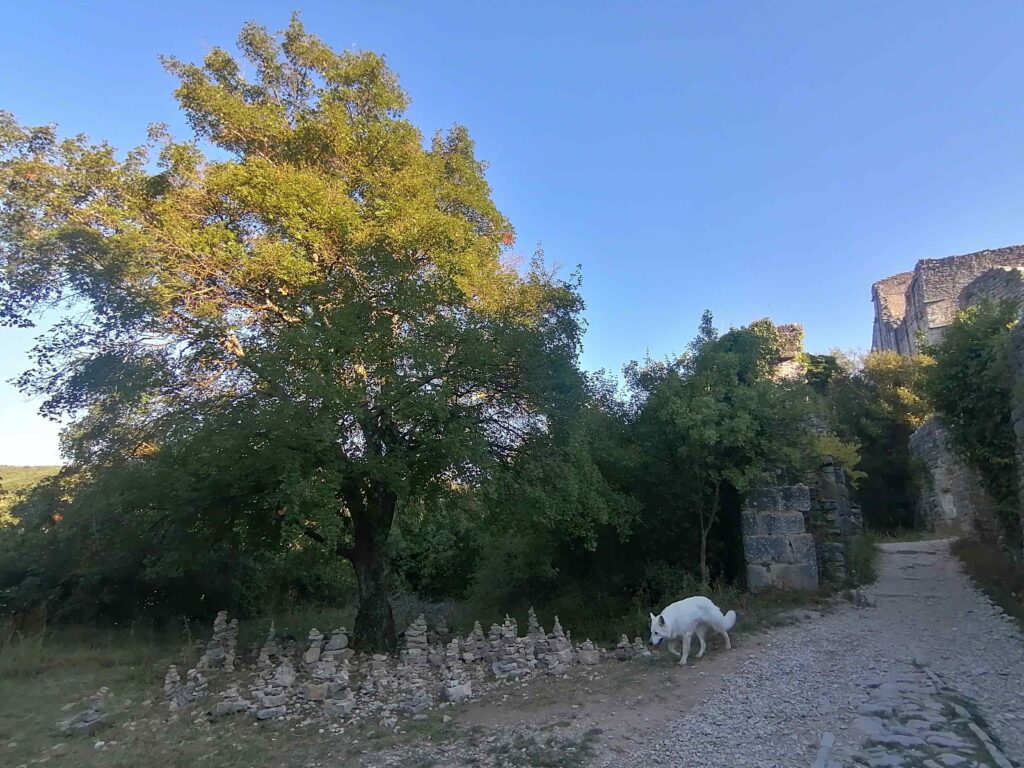
Early in the morning of 8. 8. (the highlight of the Lion’s Gate portal), Tara and I first drove to the medieval city ruins – to Dvigrad.
Dvigrad is located in the interior of Istria, near the town of Kanfar, approximately 20 kilometers southwest of Pazin, in the Limska draga (karst valley, an extension of the Lim channel). The name Dvigrad is said to have originated from two castles in the town, which are now in ruins.
The location was inhabited in prehistoric times, the town was first mentioned in the 9th century. An important find, dating back to the time of the Roman Empire in this area, is an altar to the autochthonous Istrian deity Eja, which indicates a kind of coexistence between the natives and the Romans. In the Middle Ages, it represented an important strategic center. In the 17th century, the inhabitants finally left the town due to diseases, wars, and problems with water. The ruins are today one of the best-preserved medieval complexes in Istria, and the Medieval Music Festival is held in their shelter between August and October.
Pogačnik says the following about Dvigrad:
“In front of the entrance to Dvigrad, elven creatures erected a megalithic sign in ancient times: a rock wall resembling a giant’s hand, with outstretched fingers reaching from the underworld towards the starry sky. The ruins tell the story of Dvigrad as the entrance to the kingdom of the elemental creatures of the Earth – the so-called dwarves. People were allowed to settle at the entrance to the underworld and transformed the intense flow of forces between the underworld and the Universe into worldly goods. However, when people began to exploit the goodness of the elemental creatures for selfish purposes, the dwarves chained the city to the breath of the underworld, so that life drained away. Only magnificent bones remained of the city.”
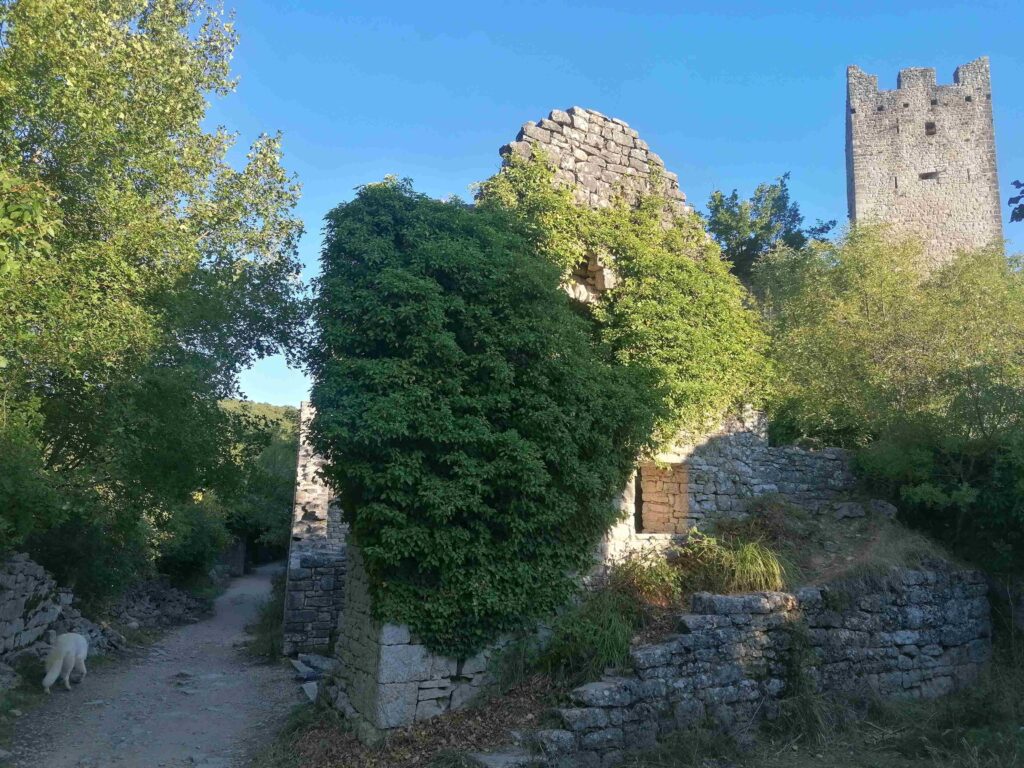
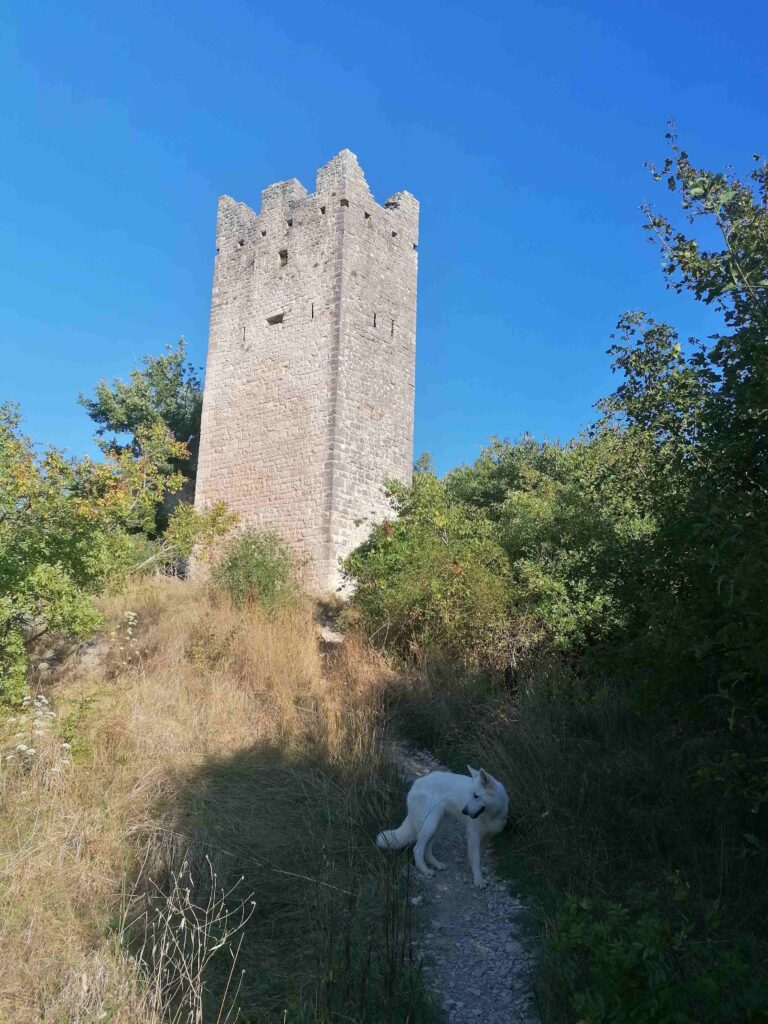
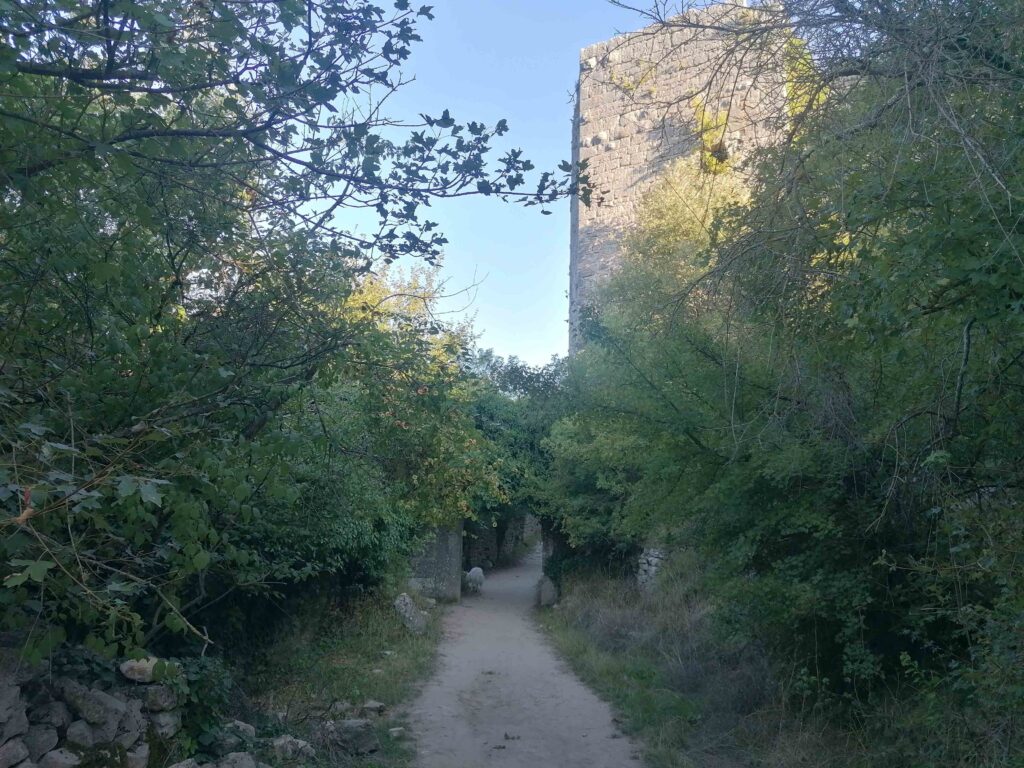
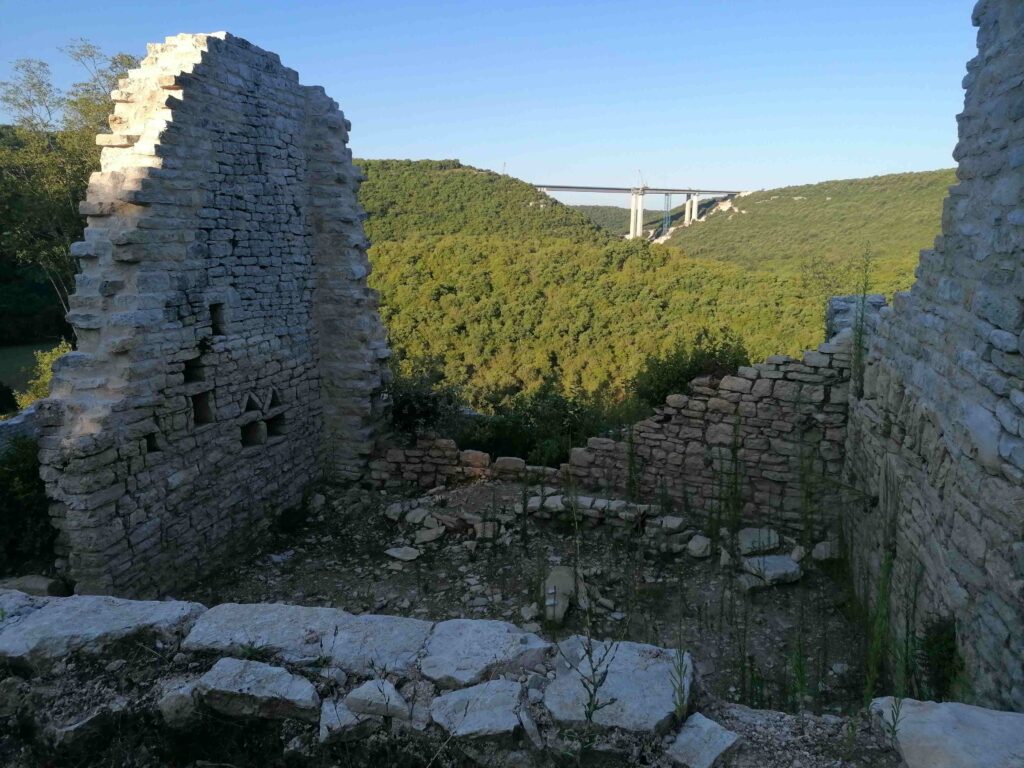
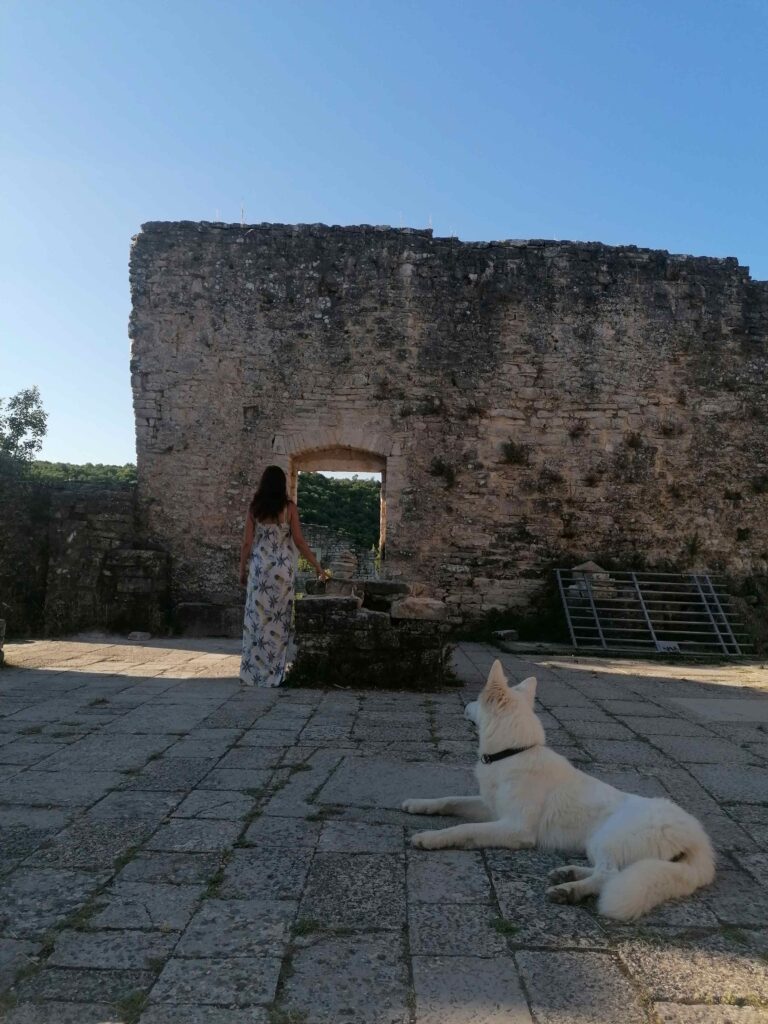
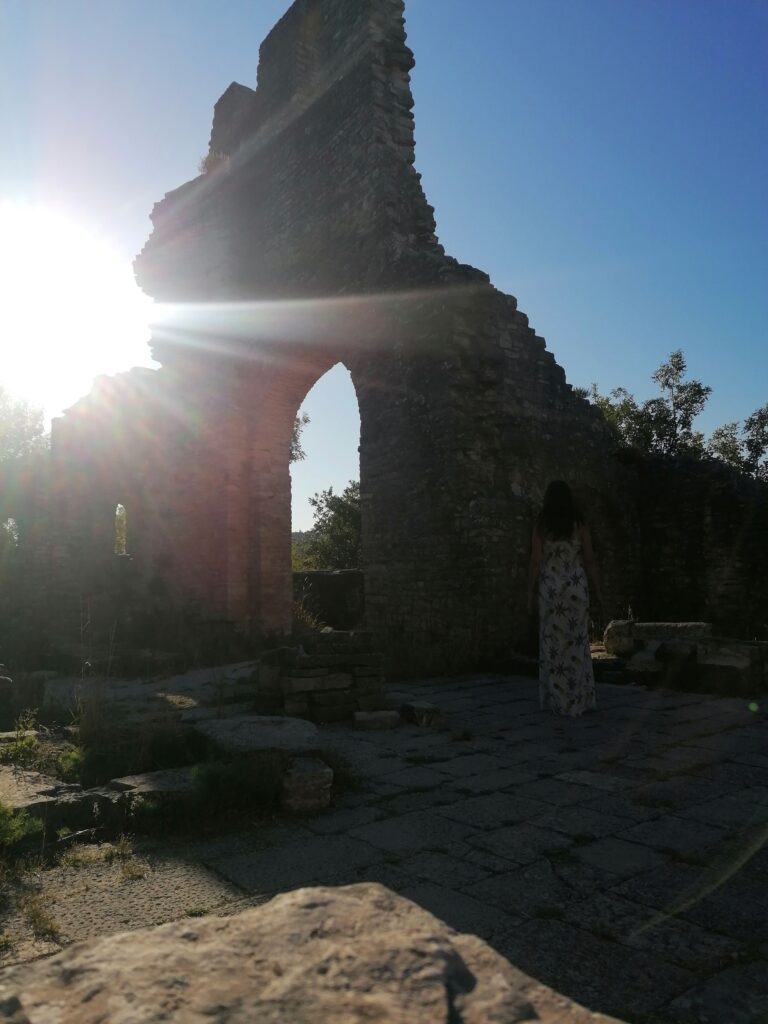
I took advantage of the sunny morning of the portal on August 8th for a rather unusual and, in the lonely morning silence, a little scary walk among the ruins. In the largest space, I apologized to the invisible beings for human selfishness and ignoring ancient agreements. I should mention that during this, I was shaking all over my body, even though the temperatures had already started to rise towards 30 …
LIM CANAL
After Dvigrad came a short path, during which, instead of Romuald’s Cave in the Lim channel, Google navigation led me to the Monastery of St. Michael above Lim. Apparently, this is one of the most important monastery complexes in Istria, originally inhabited by Benedictines, and there is also an early Christian church of St. Mary from the 6th century.
In the nearby forest, my dog and I came across the Water Path, which, after about an hour of wandering mostly in the shade of trees, led us to a secluded beach – Kloštar beach. I was happier than I would be in the crowded ‘Pirate Cave’, because the solitude allowed me the freedom to throw off all my clothes and swim naked in the refreshing seawater. Thank you, monastery beach! 😀
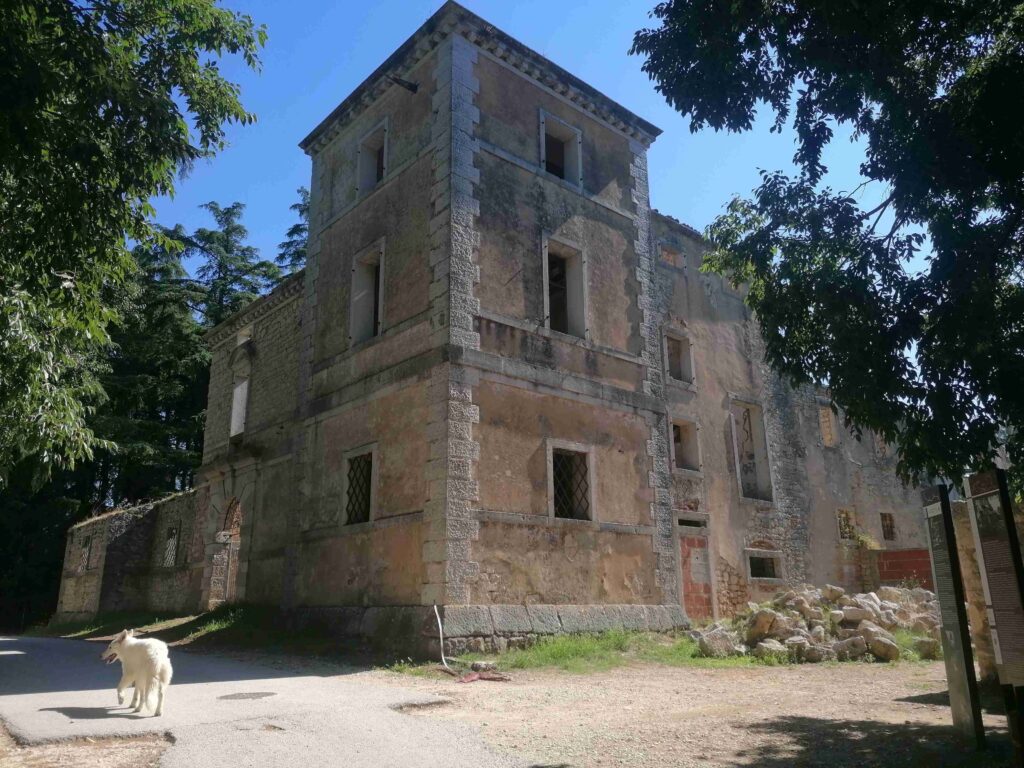
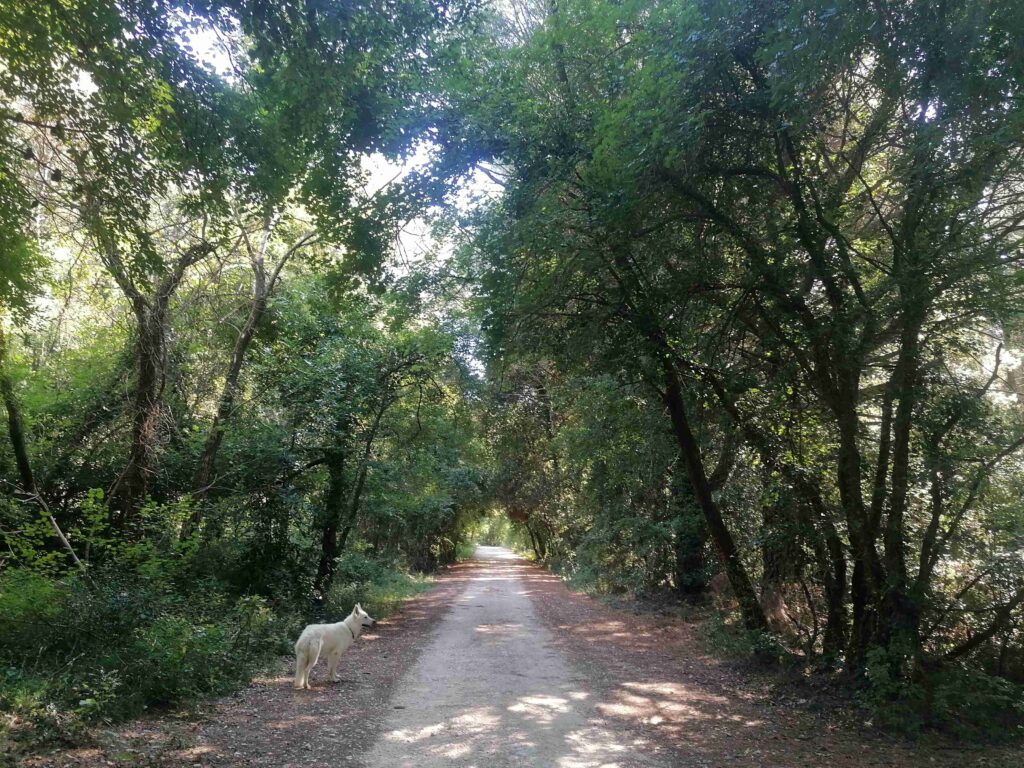
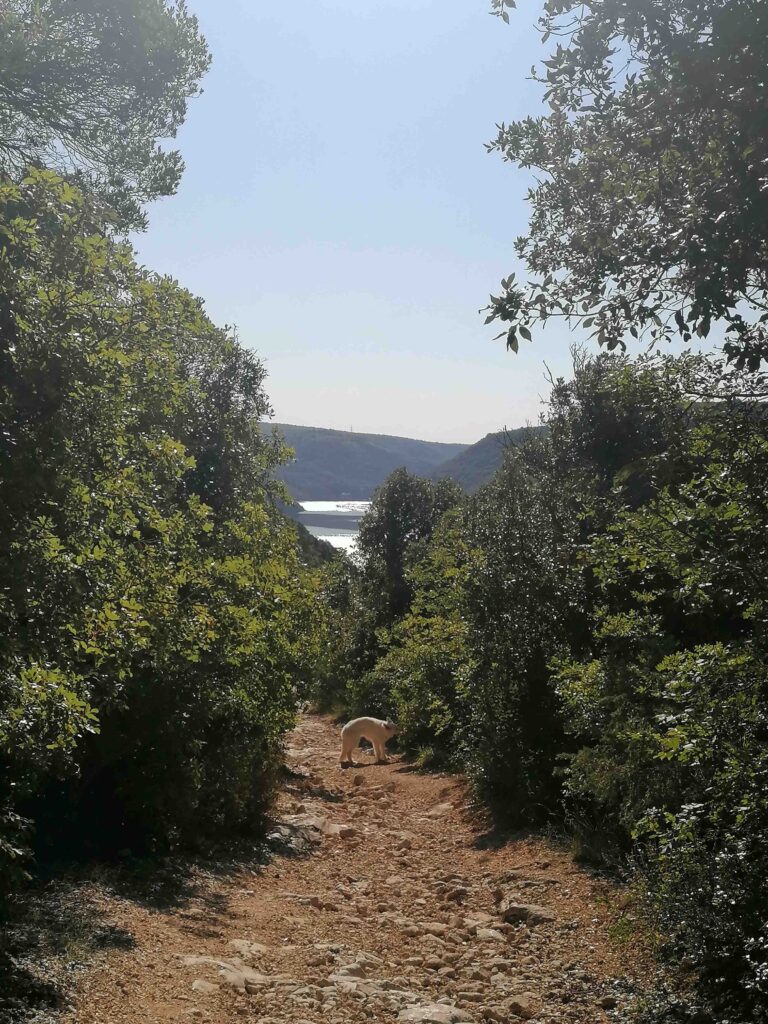
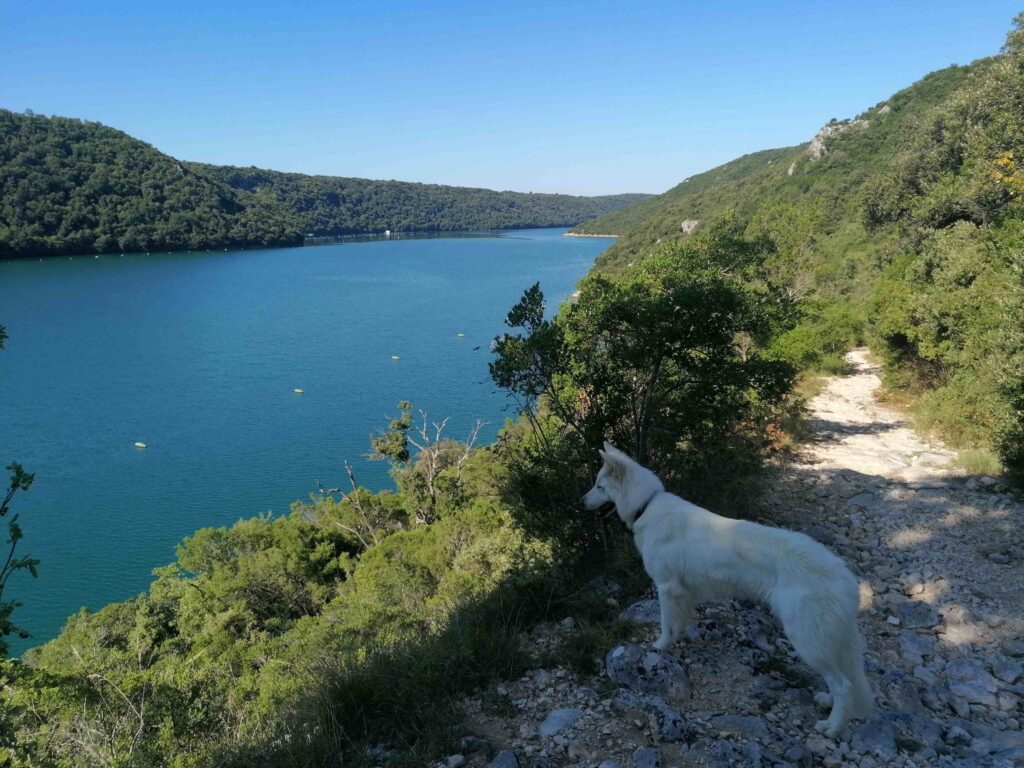
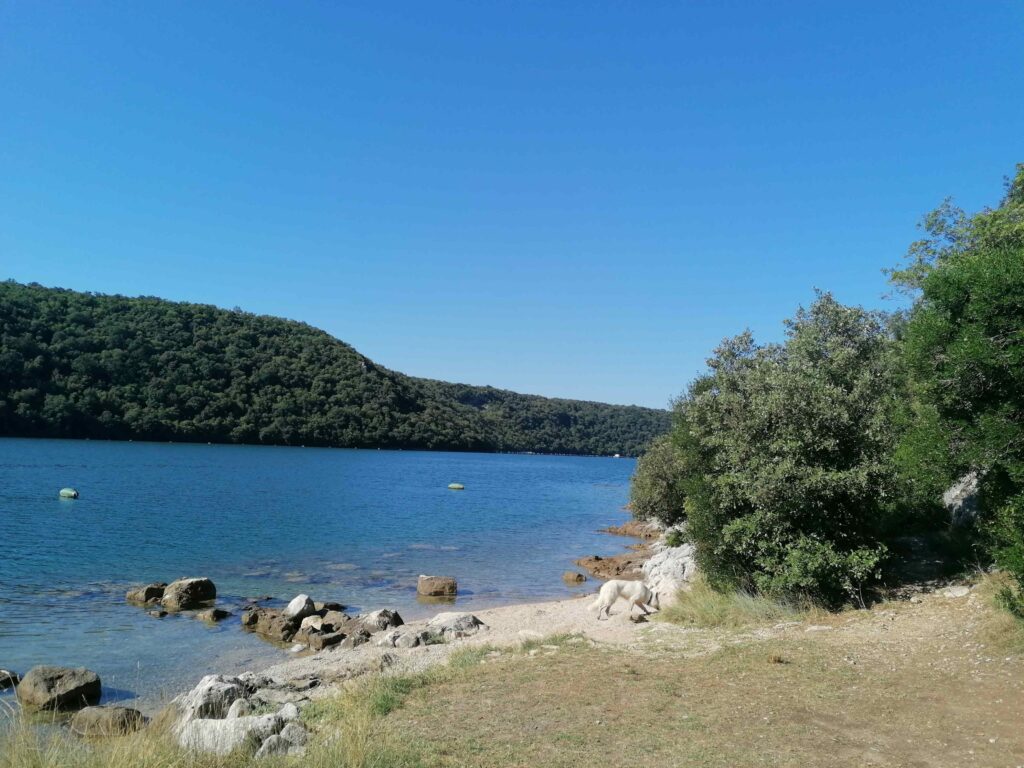
Pogačnik about the Lim Canal writes: “The tree of Istria would grow peacefully towards the peak in the shape of Cape Kamenjak, if the landscape were not almost bisected in the middle by the Lim Fjord. First, it runs in the form of a longitudinal water bay in a west-east direction, then turns north in the form of a dry channel and ends in a hellish abyss on the edge of Pazin. With the Lim Fjord, we find ourselves on the threshold of the Istrian mystery. In addition to the horizontally stretching wavy landscape, Istria knows another dimension, revealed through the Lim Fjord channel. From there, the Istrian underworld spreads northward, rich in mythical creatures of an elven and dwarf nature. If you want to experience the energetic underworld of Istria, the best option is the places along the described earth fault…“
Where am I stuck?
The next plan was to explore more of the wonderful Istria, including Poreč, but that’s where everything got ‘stuck’. My car (its right window) started to protest, and the two-month agony of breaking various parts, searching, waiting, and repairing… began. I ran out of will and energy to visit the megalithic circle on Mordela (or Croatian Stonehenge), which ensures contact with the world of ancestors and descendants, listen to the unique mix of Croatian-Slovenian-Friulian dialects in Čičarija, get to know the mighty dragon’s back of Mount Učka…
Well, I did it, the next plan to explore the wonderful Istria included Poreč, but that’s where everything got ‘stuck’. My car (or rather its right window at first) started to protest and the two-month agony of breaking various parts, searching, waiting and repairing began… I ran out of will and energy to visit the megalithic circle on Mordela (or Croatian Stonehenge), which ensures contact with the world of ancestors and descendants, listen to the unique mix of Croatian-Slovenian-Friulian dialects in Čičarija, get to know the mighty dragon’s back of Mount Učka…
I only got my car back with a non-working (otherwise moving) roof in October, and spent two months dealing with obviously unresolved toxic relationships from the past. In the meantime, I was constantly receiving posts on Facebook about pathological narcissists. Once, I was listening to how to recognize such a person, when a message appeared on my telephone screen in which I could immediately tick off what I had just heard. But I was aware that it would be the easiest to blame everything on someone else, in this case on the male world, but things have different backgrounds, deep roots … and their own purposes …
That boundaries need to be established was most clearly demonstrated by Tara. She stopped retreating or submitting to aggressive dogs and hit back. I was … horrified by her immense strength, speed, focus, perseverance, intransigence … Luckily, the Croatian dog, which Tara had been avoiding for 2 months before, but this time she did not ‘devour’ the game rules violation, was about the same size and just as hairy, so there was no bloodshed. With the combined efforts of both guardians, we pulled Tara off her. The guardian of the other dog was an elderly gentleman, with whom we had often chatted in the park before. He saw who had started the brawl, and still claimed that they were friends, but I do not want that kind of friendship… I also do not want my dog to be isolated (separated and lonely) from the others, as suggested by a passerby who saw what the game had turned into and had experienced something similar herself. I also did not listen to my childhood ‘friend’ who nodded, saying that you should never trust a dog. Maybe during that period I really lost trust in her, in myself, in people, dogs, the whole world…, but the situation improved in the following months.
First, I had to think about where I was withdrawing or subjugating myself. It quickly became very clear that for some time now (again!) I have been receiving almost daily ‘counseling’ about what to think, what to feel, what to do, how to behave, what to fear… and my choices/emotions/thoughts are never right or ‘good enough’. Which is just control, codependency, and fear, disguised as ‘care and love’. It won’t work. I know too much (knowledge is power) and I see the games in the background that take away a person’s sovereignty and power, self-confidence and self-esteem, to become willing puppet…
In the area of emotions, which primarily govern our lives, Joe Hudson is working miracles with free recordings and podcasts, such as this one. Or Peter Crone with countless recordings about his version of freedom…
In October, it turned out that treatment in this area was successful. But what exactly is treatment? Feeling and then letting go of repressed (‘unpleasant’) feelings. Apparently, there’s no other way – in 20 years, I’ve tried almost everything. 😀 Not pleasant at all, very painful and extremely tiring. Just killing the courier of emotions is not exactly wise or effective.
When I got the car back, I first waited another 3 weeks for the official service, where they were supposed to inspect the roof and find out the cause of the malfunction. But they didn’t do that. The car is supposedly too old, there is too much work, the spare parts are too expensive… for them to even bother looking at it. To their credit, they fixed the annoying beeping sound (Roof maneuver is not complete!) in the car that was going through my head for free.
Ok! I understand! 😀 Immediately after the visit to the mechanics, the same day, Tara and I drove to the Island of Brač to find some peace and recovery. And we found it…