Socerb
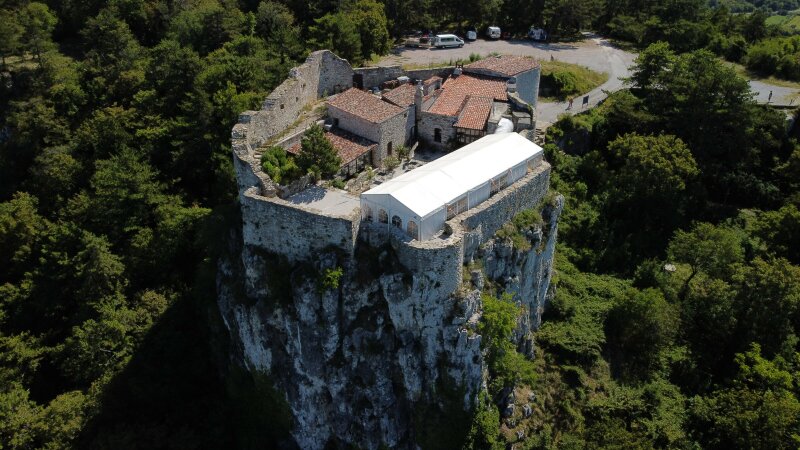
The exhalation center of the respiratory system of the Karst landscape sanctuary is located on the southern edge of the Karst above the Gulf of Trieste – writes Marko Pogačnik in his book Slovenia the Miracle. This is a mighty columnar cliff on which stands the Socerb Castle (or Strmec Castle):
“The information contained in the exhalation crystallizes on the cliff walls in the form of salt droplets – not materially, of course, but on a subtle level of reality. The rock sweats, and the salty ‘sweat’ contains the information of the exhalation. Winged beings from different dimensions fly in, take a drop of sweat, and carry it into the world as a message from the Karst. Winged, bird-like fairy and angelic beings shower and depart, so that the Karst continues to share its essence with the world.”
The website visitkoper.si states that Socerb Castle, the only major fortification on the Karst Edge, dates back to the 9th century and has been renovated and expanded several times over the centuries. In the 14th century, it was owned by the Venetian Ducaini family, and then changed owners several times. In the 16th century, it was a key point in the struggle between the Austrians and the Venetians for control of the salt pans in Zaule. The castle was severely damaged in 1780 by a fire caused by lightning and began to decay.
It was renovated in the 20th century and today serves as a popular excursion point, where visitors can enjoy the view of the Gulf of Trieste and the surrounding landscape. Near the castle is the the Holy cave, a karst cave with the only underground church in Slovenia. It was a popular pilgrimage site in the past. Legend has it that St. Socerb lived there as a hermit for two years.
Socerb was born in Trieste. At the age of 12, he left his home and found a new home in a cave above the edge of the Karst. This cave is today called the Holy Cave or Socerb’s Cave. He spent one year and nine months there as an ascetic.
After that, he gained special power and performed several miracles, especially healing the sick. These miracles and Socerb’s persistent preaching of Christianity did not please the authorities, because at that time Christianity was not yet officially permitted. The Roman imperial governor therefore imprisoned Socerb and tortured him to death …
The area around the castle, which is registered as a cultural landscape, I visited almost every week during my 14-year stay in Slovenian Istria, getting to know it in all seasons and all weather conditions. First, I explored it with my golden retriever and enjoyed the winter snowflakes, then I wandered along countless paths with Bernese mountain dog, and finally I retreated here from the crowds on the Coast with my white Swiss shepherd.
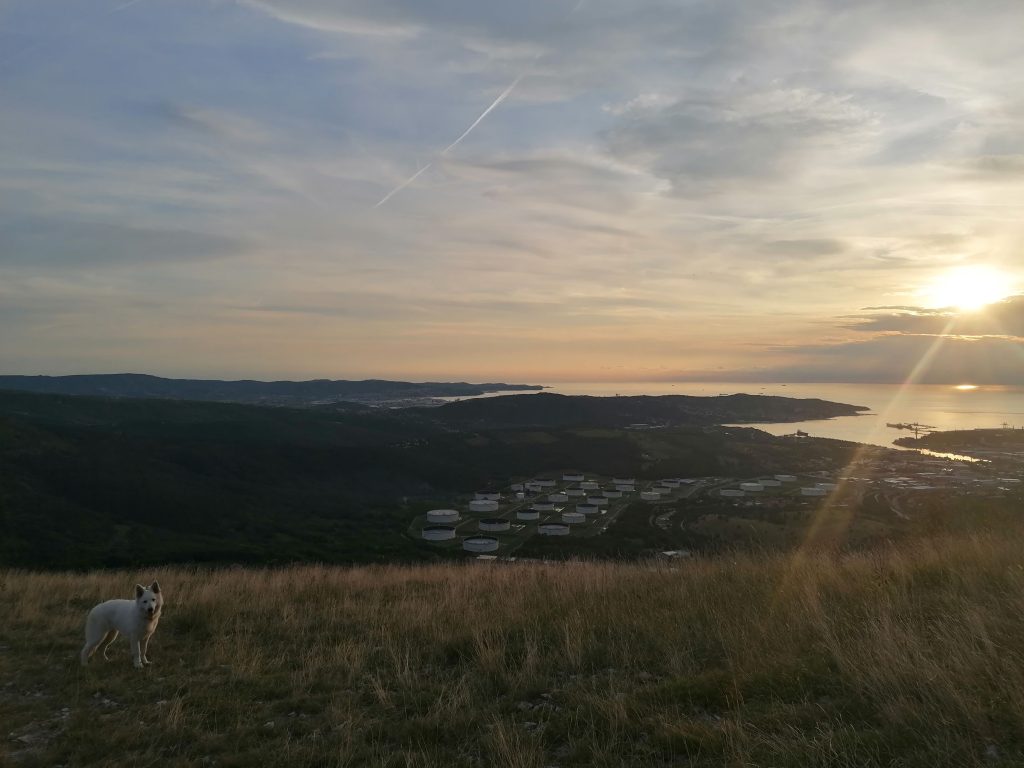

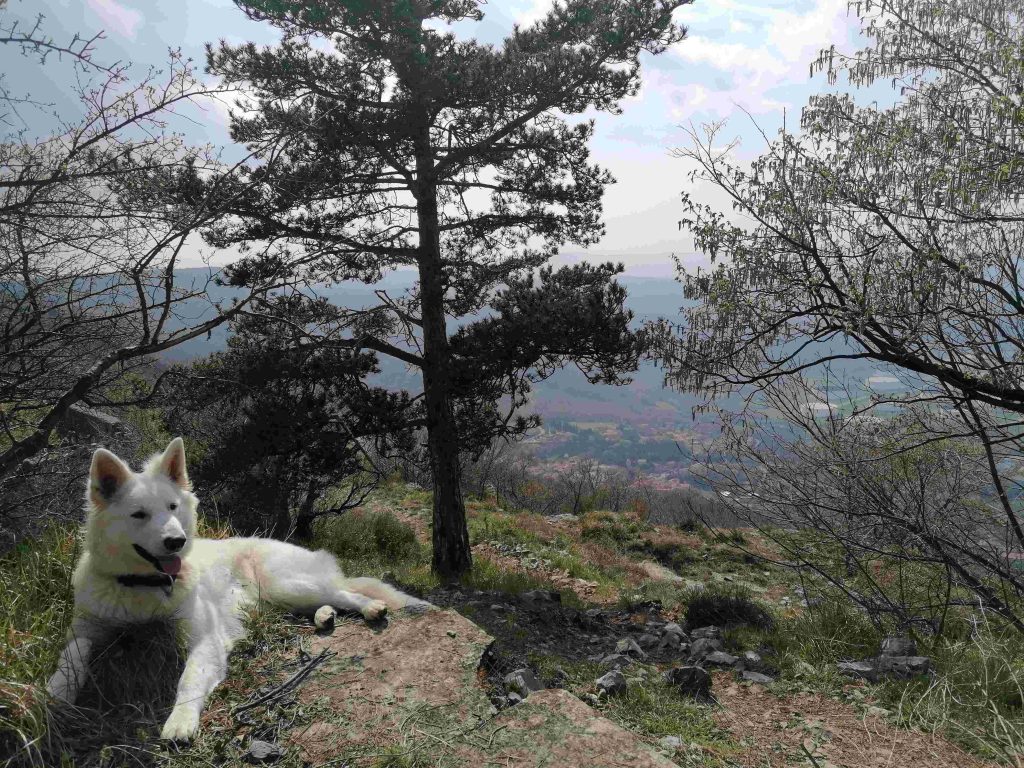
Pogačnik claims that the process of life formation is initiated in the underground of the Karst, even before it appears on the surface of the planet. The first unpleasant feelings appeared in front of the Holy Cave, where my colleague and I both felt that behind the bars that close the interior of the cave, something was trying hard to free itself. A few years later, the black bull that Tara (a white Swiss shepherd) and I met near the castle reminded me of the poem by Dane Zajc: Great Black Bull.

Great Black Bull
The great black bull bellows in the morning.
Great black bull, who are you calling?
The pastures are empty.
The mountains are empty.
The gorges are empty.
Empty like the echo of your call.
The great black bull bellows in the morning.
As if spraying dark black blood
over the crowns of dark pines.
As if the bull’s bleeding eye
had spilled open that morning
over eastern forests.
Great black bull, who are you calling?
Do you take pleasure in hearing
how your hollow scream
returns as an echo?
Great black bull, bloodless is the morning.
Your voice falls into gorges
like a tattered swarm
of black ravens.
No one hears your solitude.
You quench no one’s thirst
with your black and bloodied voice.
Be silent, great black bull.
The great black bull bellows in the morning.
The eastern sun sharpens
its glistening hatchet.
Translated by Erica Johnson Debeljak
But his message, just like during the first reading in high school or studying it for the exam from modern Slovenian poetry, was still not completely clear to me. A summary of the explanation on dijaški.net says the following:
The starting point of Dane Zajc’s poems were experiences of war, death, cruelty, and later, meaningless individual and social existence. Zajc’s poetry reveals his complete loneliness, his powerlessness to resist internal forces. According to Zajc, man is his own executioner and victim. The poet is called to confess this horror as a prophet or seer of the subconscious horrors of his own and other people’s lives.
The style of Zajc’s poetry is visionary, prophetic and ecstatic. He adopted many characteristics of the biblical style and expressions of archaic religious texts.
His poetry was not initially accepted due to its uniqueness, so he had to self-publish his first collection.
The poem Veliki črní bik (The Great Black Bull) was published in the collection Požgana trava (burnt grass) and soon established itself as an important autobiographical creation of Dane Zajc. The poem exudes an ancient ritualism that reminds us of the characteristics of primitive peoples. The bull represents a strong, stubborn, wild animal. It personifies power and energy. The bull finds himself in solitude, everything is empty, as is its echo. He roars into space, but there is no answer, all that is is solitude – man is lonely. Everything is meaningless, you remain alone. The bull’s roar intensifies. Zajc writes he should be quiet, because the butcher – death awaits him. The great black bull, with its echo, answers only to itself, in the middle of an empty, deaf space, all its power is absurd. The annihilation of this power comes from outside.
It is a symbolist and expressionist poem (the sun – a symbol of death; the bull – a symbol of a helpless man; the bull’s voice – the voice of the poet) …
Dane Zajc may have visionarily predicted almost 60 years ago how ‘butchery’ was being prepared in the East, but in my time, many wars in this area are (unfortunately) a common practice of humanity. But I was wrong. A few months after this reflection, it turned out that the events in the East had shifted into an even higher gear.
Napad Hamasa v Izraelu me iskreno ‘povedano’/napisano pravzaprav sploh ni presenetil. Že pred časom sem slovenščino učila Palestinca, ki je izraelski zapor doživel kot 11-letni deček. Ta mi je na svojem telefonu pokazal posnetek, kako oboroženi izraelski vojaki nadzorujejo njegovo družino. Ta je obirala oljke, nato pa so jim vojaki ves pridelek pobrali in odnesli. Upor je bil tako v mojih očeh (žal) pričakovan.
I spent the day of the terrorist attack, unreachable in the safe haven of the Dragonja River Valley. When I read articles the next day about the horrors that took place at a festival near Gaza, I was even more surprised by the fact that at the same time I was experiencing a slightly different occupation by a former Russian soldier. Since my grandmother was Ukrainian, I found this a very meaningful coincidence. But force was not needed here, everything happened in such a way that ‘my borders’ were preserved without violence. After a few minutes of staring eye to eye, tears flowed from his eyes, and countless: Sorry, sorry, sorry… came out of his mouth. I was the first person to do something similar – to look and see his soul…
Ears of Istria – Dragon’s Nest – Veli Badin
One of the ‘whispers of the future’ took place under the Veli Badin by the border with Croatia. After about an hour walk from the church of St. Kirin along the ridge of the Karst Edge, you come to a wall that resembles large elephant ears. When I was here for the first time, I asked them what they were listening to, and was surprised to hear the thought: ”The Karst will burn”. Of course, I dismissed the possibility of a disaster, saying ‘I’m just imagining it’. Large fires can rage elsewhere in the world, but disasters ‘don’t happen at home’…
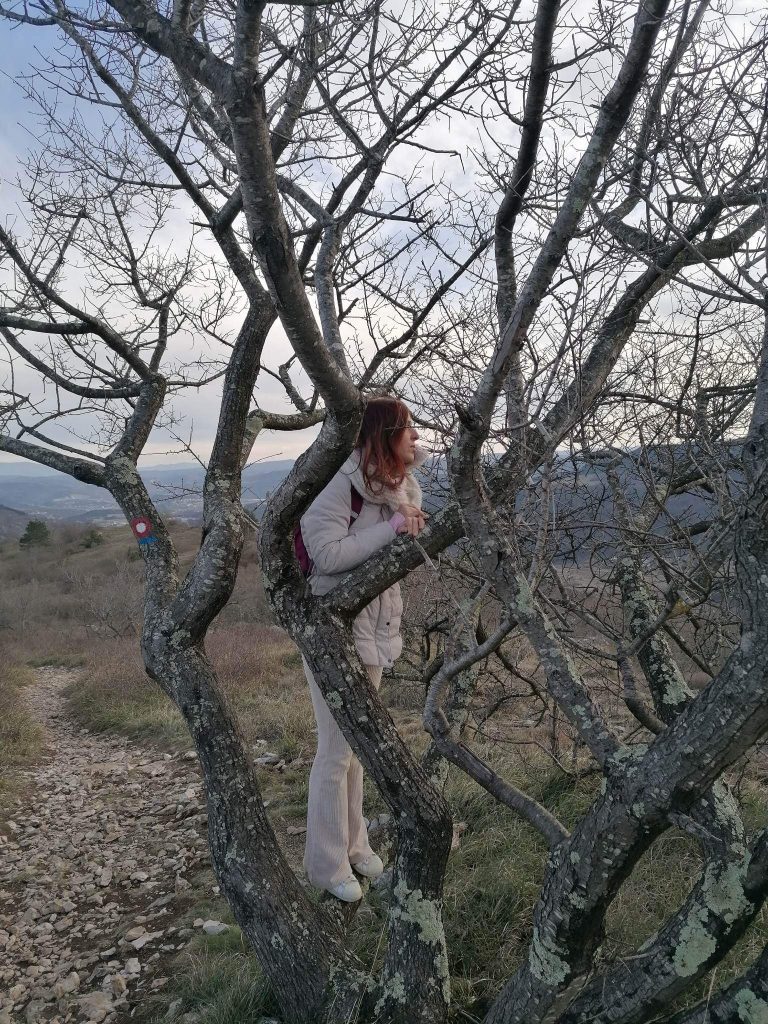
It came true 2 years later. But just like during Covid, the universe took very good care of me this time too. On the first day of the fire, I traveled to the Maldives, where I was showered profusely for the entire next week, while half of Slovenia was meditating for rain. I returned when the fire was already under control, and after 22 hours of sleep, I woke up to a storm – the first rain since the fire broke out – that finally extinguished the fire and chased away the remnants of the smoke screen over the Coast.
That it was probably not a coincidence and that a person can sense the future occurred to me during my next visit to the Dragon’s Nest in the company of a Serbian woman who translated Slovenian folk tales into Serbian. I took her there to read them on the border with Croatia, with a view of the border crossing (Sočerga).
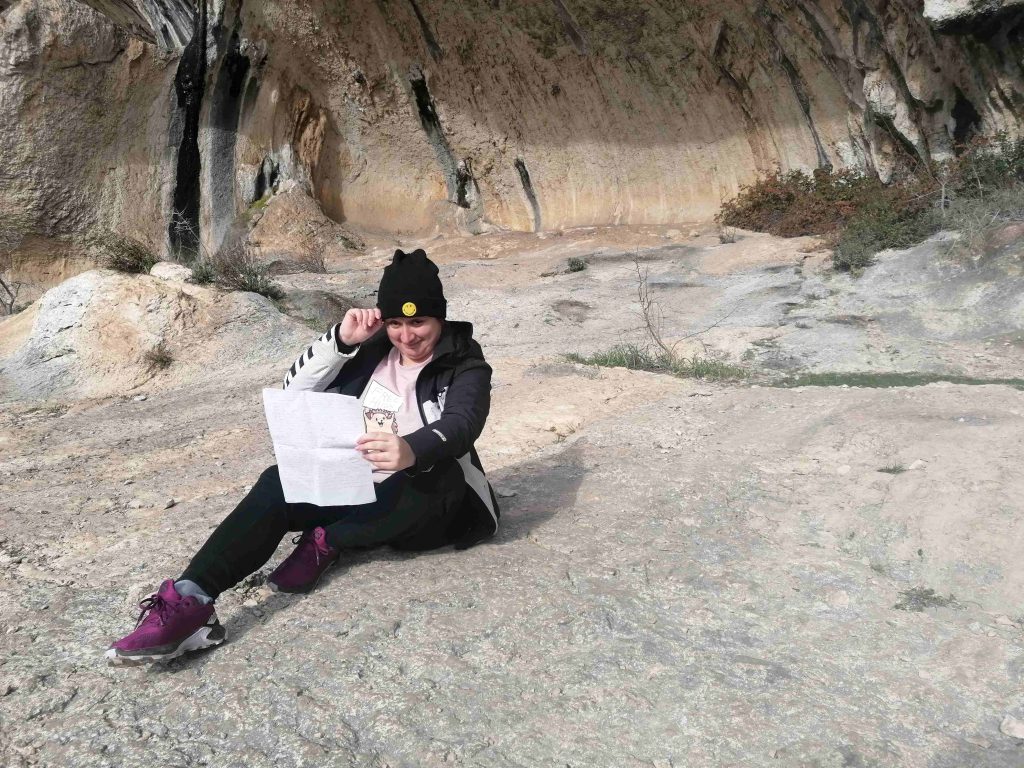
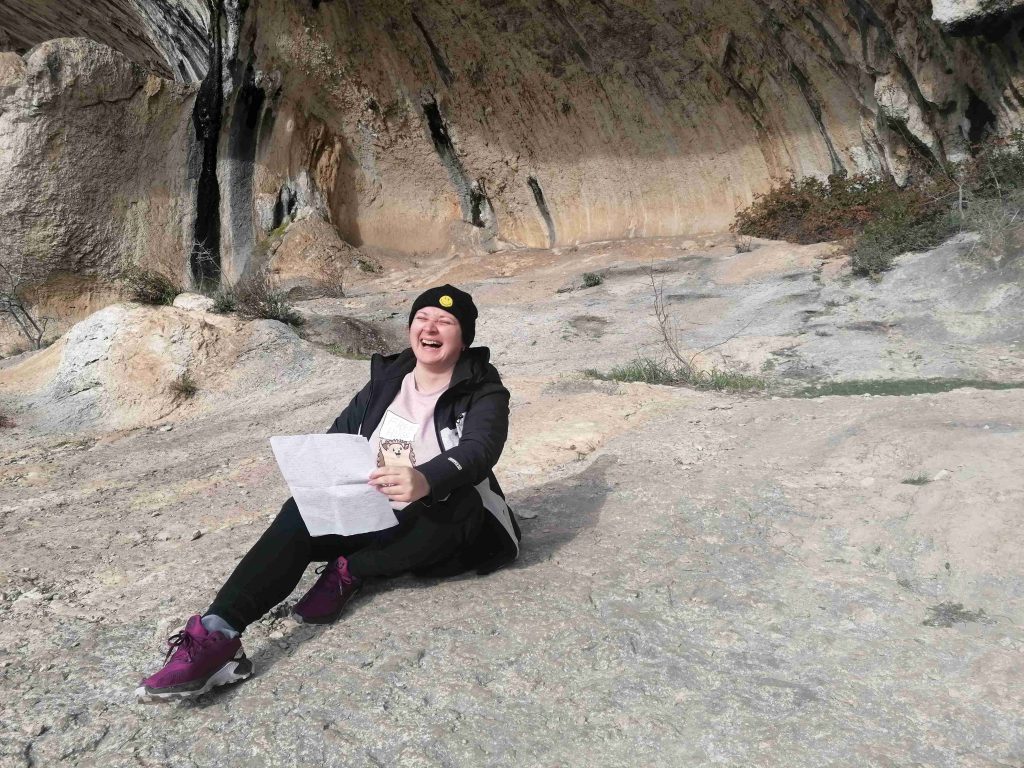
I told her about the ‘hint’ about the fire, then playfully asked: “What are ears listening today??” At that moment, the sun shone through the clouds, which Ana also noticed. It made us both laugh, and my thoughts turned to my ‘little sun’ – my deceased golden retriever, whom I still missed very much.


A month later, Tara was born and joined me after four months.
The route along the Karst edge: Socerb-Varda-Črni Kal-Osp-Socerb
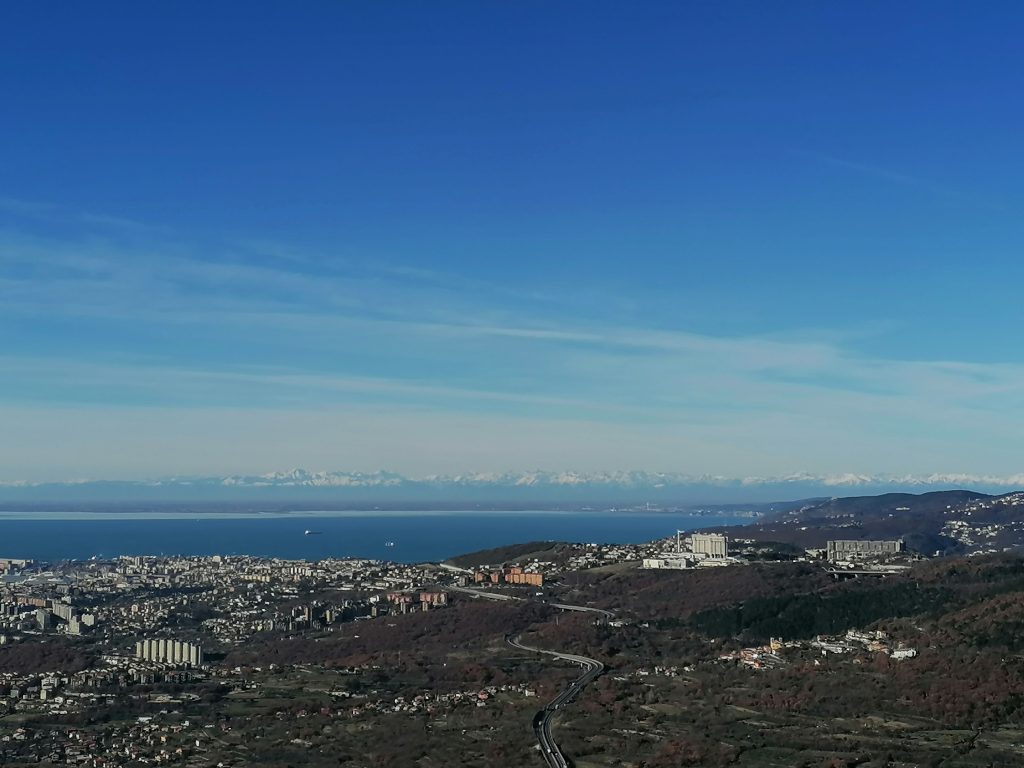
Tara and I started visiting the Karst regularly, every week, sometimes several times. One of the most beautiful trips was the P3 route, which we started at Socerb and saved the most difficult part (the climb back towards the castle) for the end. Here, in addition to the beautiful views of the Gulf of Trieste, my attention was drawn to the Črni Kal viaduct, which I was able to observe from several different angles and also walk under. The bridge between the Karst and Istria, between ‘the mainland and the coast’ – as the people of Primorska say. I wondered what it was telling me, and I got the answer in the form of a quote:
Poetry is not just a dream and a vision; poetry is the skeleton of the architecture of our lives. It lays the foundations for a future of change, a bridge over our fears of what has not yet happened. – Audre Lorde
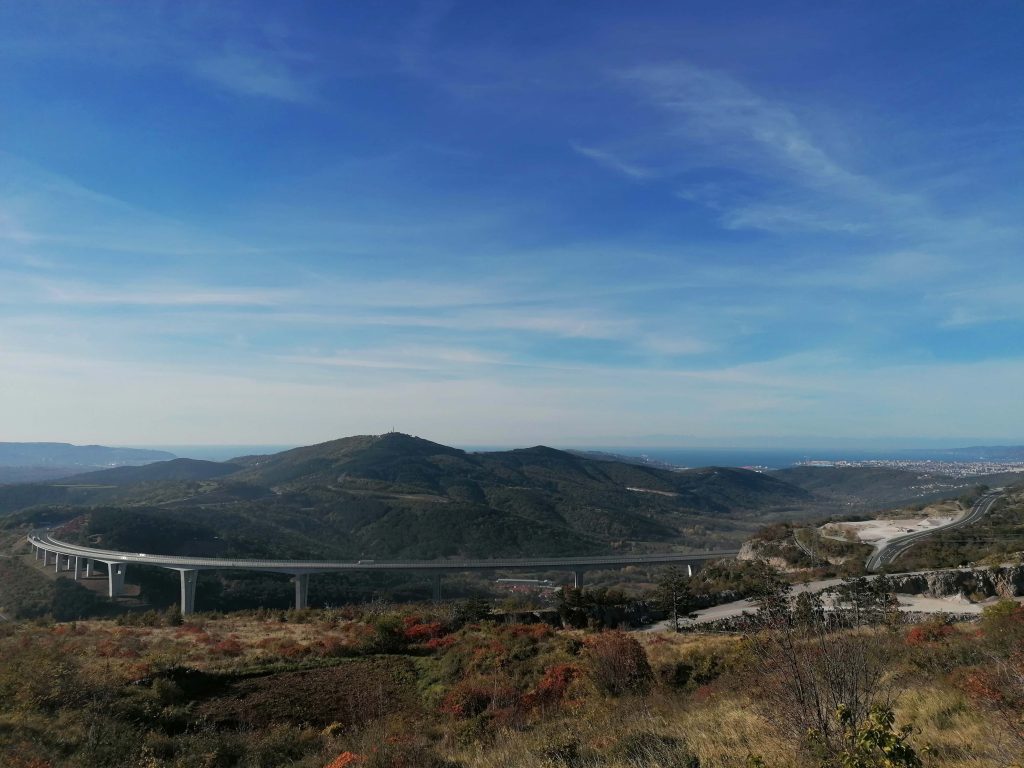

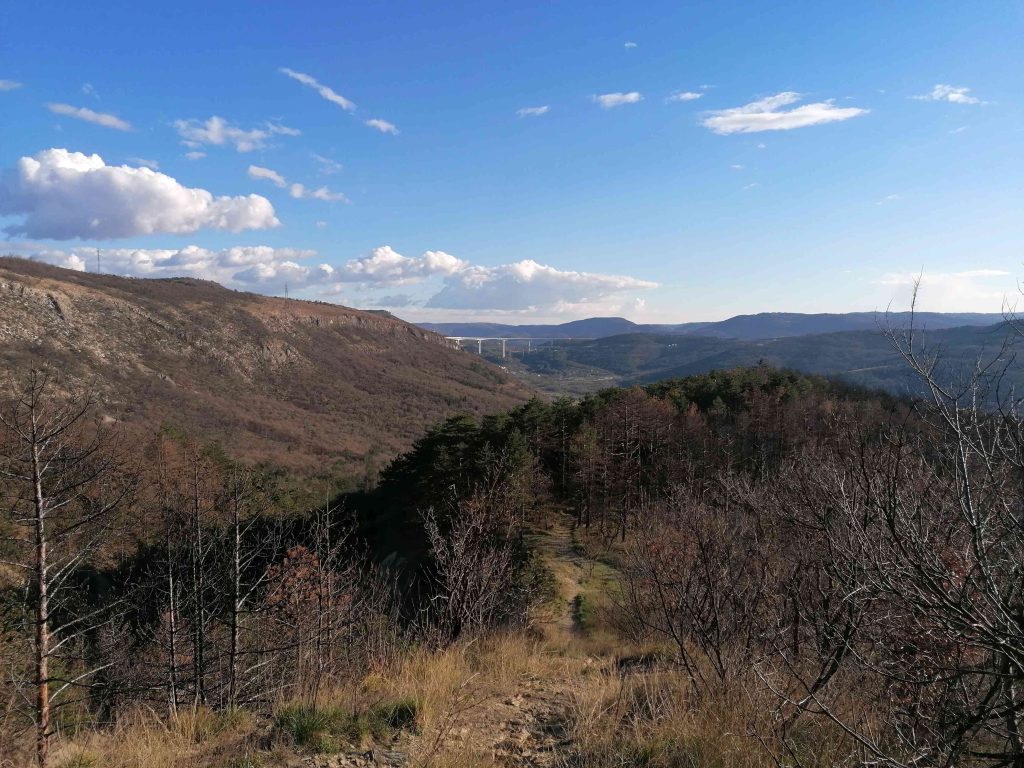
And what has ‘not yet been’? Who/what is the architect of life? What forms the skeleton of our lives?
Church of St. Mary of the Snow
There are several legends about the reasons for the construction of the church in Gradišce, which for a long time represented the destination of God’s path. A nice footpath leads to it. It stands on the site of a prehistoric hillfort, about which Pogačnik says the following:
“The stone mounds of karst sanctuaries are a medium for communication between the human race and the divine core of the Earth. Archaeological science today interprets them as fortified hillforts from the Iron Age. I reject such interpretations based on my own observations. If the mounds were indeed later converted into hillforts, it was a secondary use or even abuse of the old sanctuary areas.
Gigantic piles of stones, usually stacked in circles, act like magnets with their mineral composition. They are drawn to the karst surface by the properties of water flowing deep below in underground tunnels. This creates invisible water currents on the surface that enable the fertility of the karst land.
With the help of stone mounds, the human race in the Karst participated in the processes of creation and constant renewal of the world. They were built during the time of cultures that still understood that life on the Earth’s surface is not a matter of course, but a gift from the heart of the Earth and the core of the Universe. For its sustainable existence, it is necessary to renew our own connection with the sources of life and the connection of the local community with all other beings, visible and invisible, with whom we share the miracle of living on the blue planet…” (Slovenia miraculus, p. 95)


Here I wondered why I was so drawn to places where they worshipped the Earth first, then God – first the feminine, then the masculine energy.
Possible answer: The future brings acceptance, visibility, hearing, appreciation, respect and connection of both, the goddess – the body, which connects us to mother Earth, and the god – the mind, which connects us to father Universe. And, the path or bridge between them leads through the heart …